
ISO/IEC 27071: Security and Trust Between Devices and Services
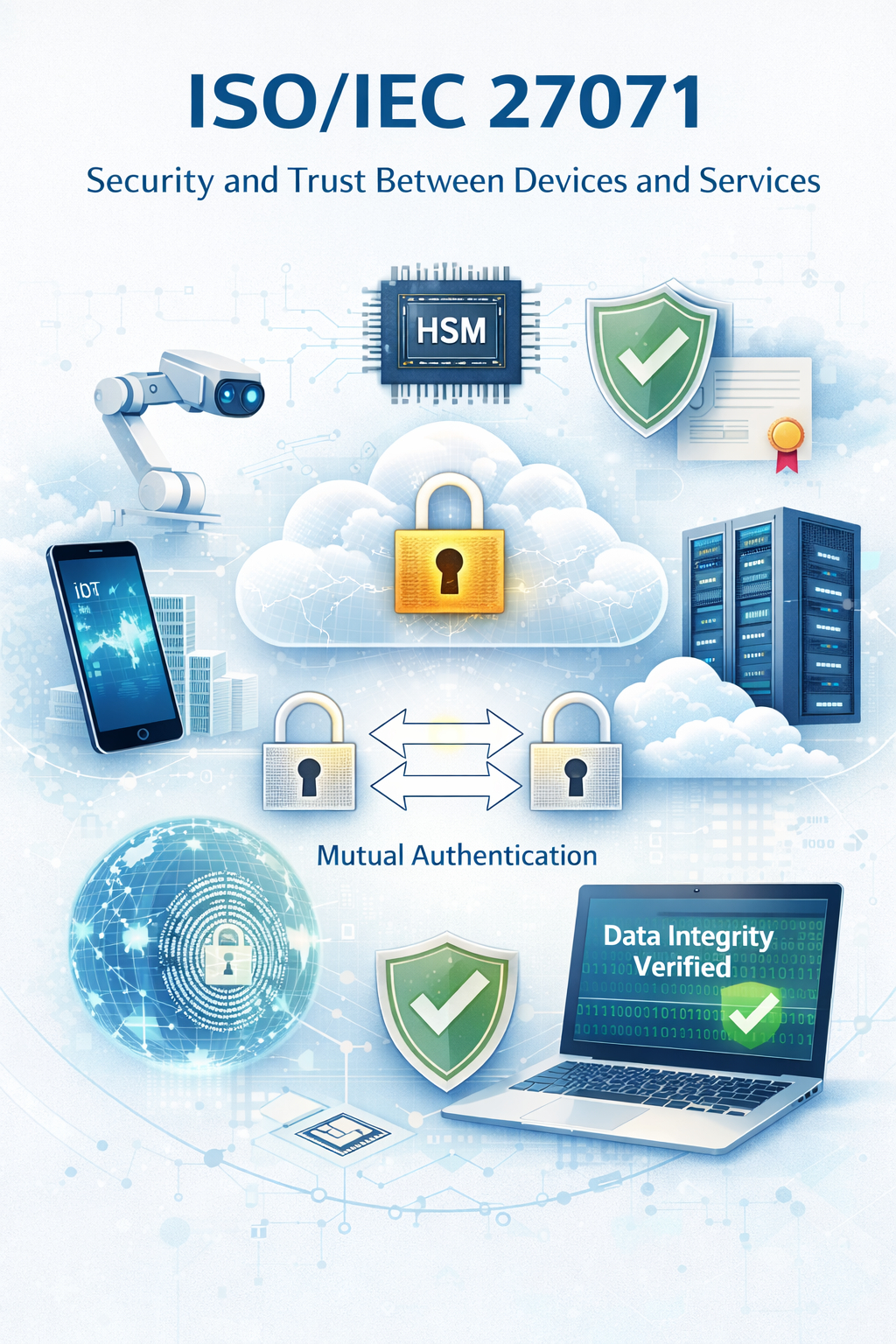 With the rapid development of the Internet of Things (IoT), cloud services, mobile applications, artificial intelligence and distributed systems, secure communication between devices and services has become a critical element of cybersecurity. In this context, ISO/IEC 27071:2023 provides an internationally recognized framework and security recommendations for establishing trusted connections between devices and services based on hardware security mechanisms.
The standard is part of the ISO/IEC 27000 family and complements other standards related to information security management and cybersecurity.
Scope and Objectives of the Standard
ISO/IEC 27071 provides a framework and security recommendations aimed at establishing trust between:
- end devices (IoT devices, mobile devices, industrial controllers, servers);
- services (cloud platforms, backend systems, digital services).
- the device communicates with the genuine and legitimate service;
- the service receives data from an authorized and unmodified device;
- the data is authentic and its integrity is assured.
Why an Encrypted Channel Is Not Sufficient
In practice, protocols such as TLS/SSL are commonly used to encrypt communications. ISO/IEC 27071 emphasizes that this is not sufficient because:
- an encrypted channel does not guarantee that the data originates from the correct device;
- it does not prevent the use of fake or compromised devices;
- it does not provide evidence of the trustworthiness of the environment in which the device operates.
Key Components in ISO/IEC 27071
1. Hardware Security Module (HSM) and Root of Trust
At the core of a trusted connection is a hardware root of trust, implemented for example through:
- hardware security modules (HSMs);
- trusted platform modules (TPMs);
- secure enclaves or secure elements.
2. Identity of Devices and Services
The standard recommends:
- unique, cryptographically protected identities;
- issuance of identities by trusted parties (e.g. certification authorities);
- the use of public key infrastructure (PKI).
3. Mutual Authentication and Key Establishment
ISO/IEC 27071 recommends mutual authentication, whereby:
- the device authenticates the service;
- the service authenticates the device.
4. Remote Attestation
Remote attestation enables a service to verify:
- whether the device is running trusted firmware;
- whether the execution environment has been compromised;
- whether the environment complies with a predefined trusted state before accepting the data.
5. Data Integrity and Authenticity
Data that:
- is collected from sensors;
- is entered by users;
- is generated by algorithms,
Applicable Scenarios
ISO/IEC 27071 is applicable to a wide range of use cases, including:
- IoT platforms and smart devices;
- industrial systems and operational technology (OT) environments;
- cloud services;
- mobile applications with high security requirements;
- critical infrastructure systems.
Relationship with Other Standards
- ISO/IEC 27001 — Information Security Management Systems (ISMS);
- ISO/IEC 27002 — Information security controls;
- ISO/IEC 27070 — Virtualized roots of trust.
Benefits for Organizations
Implementing ISO/IEC 27071 helps organizations to:
- reduce the risk of fake or compromised devices and data;
- establish trust in distributed systems;
- increase their cybersecurity maturity;
- meet customer and regulatory expectations.
ISO/IEC 27071 provides a clear and structured approach to building trust in modern, distributed digital systems. For organizations that rely on automated data exchange between devices and services, the standard is a key tool for improving the resilience and security of their platforms.
ISO/IEC 27071:2023 Cybersecurity — Security recommendations for establishing trusted connections between devices and services
Implementation of management standards
CONSEJO Ltd. is a consulting company with over 20 years of practical experience in the development, implementation and maintenance of management systems in accordance with international standards and regulatory requirements. The company provides consulting services in the areas of quality management, environmental management, occupational health and safety, food safety, information security, cybersecurity, risk management and sustainable development. Our expertise covers standards and schemes such as ISO 9001, ISO 14001, ISO 45001, ISO 22000, ISO/IEC 27001, IFS Food, BRCGS and HACCP, as well as consulting services related to NIS2, DORA, GDPR and EcoVadis.
The CONSEJO team has been involved in over 1,500 projects for organizations across various sectors of the economy, including manufacturing, construction, energy, information technology, transport, trade, the food industry and services. Our approach focuses on developing management systems that work effectively in practice, tailored to the specific characteristics and needs of each organization. We work closely with our clients, providing consulting support, staff training and assistance during implementation. We strive to deliver high-quality services within the agreed deadlines and solutions that support successful certification and create long-term value for businesses.


