
VSME – the New Voluntary Sustainability Standard for SMEs in the European Union
A new standard helps small and medium-sized enterprises meet sustainability requirements with reduced bureaucracy.

VSME (Voluntary Standard for SMEs) is a voluntary sustainability reporting standard developed by EFRAG under a mandate from the European Commission. Its aim is to make it easier for unlisted micro, small, and medium-sized enterprises to provide comparable sustainability information when large companies and financial institutions request it across the value chain or for access to financing. The Commission encourages large companies and banks to use VSME in order to avoid disproportionate demands on SMEs.
Who can use it?
The standard is voluntary and intended for unlisted SMEs. Definitions of micro, small, and medium enterprises follow Directive 2013/34/EU (e.g., micro-enterprise – balance sheet ≤ €450,000, turnover ≤ €900,000, employees ≤ 10).
VSME is aligned with European standards (ESRS), but proportionate to SME resources, and it does not carry legal force as a delegated act.
How is the standard structured?
VSME is organized into two modules: Basic and Comprehensive.
- Basic module – mandatory starting point; targeted at micro-enterprises.
- Comprehensive module – adds indicators often requested by banks and corporate clients.
Basic module (minimum for all; targeted at micro-enterprises):
- B1–B2: report foundation; policies and initiatives for sustainable transition.
- Environment: B3 energy & GHG emissions; B4 pollution; B5 biodiversity; B6 water; B7 resources, circular economy & waste.
- Social: B8 workforce profile; B9 health & safety; B10 wages, collective bargaining & training.
- Governance: B11 convictions and penalties for corruption and bribery.
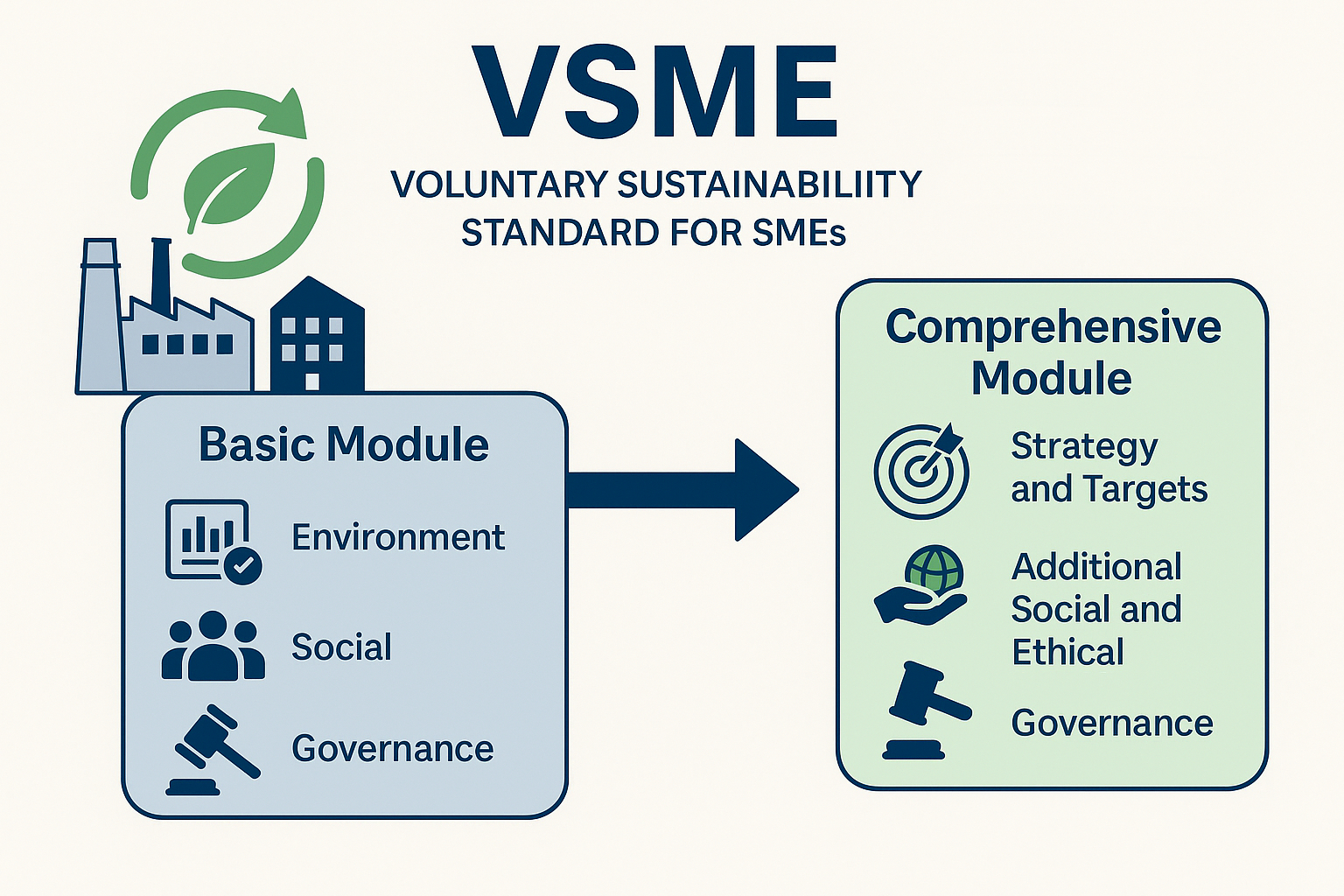 Comprehensive module (on request from banks/clients):
- Strategy & targets: C1–C4, including emission reduction goals & climate transition plan.
- Additional social & ethics: C5–C7 (e.g., human rights policies, serious incidents).
- Governance: C8–C9 (e.g., revenues from sensitive sectors; gender diversity in management).
Link to CSRD/ESRS and the “value chain cap”
VSME is not part of CSRD, but it is thematically aligned with ESRS to reduce “misalignment” across the value chain. At the same time, the “cap” principle applies – large companies should not request more information from SMEs than what is foreseen in the rules for them.
Benefits for businesses
- Easier access to financing (banks, investors) that require standardized data.
- Fewer conflicting data requests from large clients – VSME serves as a “common language.”
- Improved internal management: better tracking of risks and opportunities, enhanced competitiveness.
How to implement VSME: a step-by-step guide (practical)
1. Define scope and form a team
Decide which module to apply (minimum: Basic). Assign a data owner for each topic – energy, health & safety, waste management, training, etc.
2. Map the data
Collect information from existing sources: energy bills, workplace safety registers, waste operator contracts, HR systems. Match data to requirements B3–B11.
3. Methodologies and evidence
- For emissions (B3), use published emission factors and simplified approaches. Start with Scope 1 & 2 (direct and energy-related indirect emissions), and add Scope 3 (other value-chain emissions) where relevant.
- Record data sources and assumptions (also for water, waste, incidents).
When a requirement is not relevant (e.g., biodiversity for an office-based business), state this under B1 – the standard allows it.
5. Targets and plan (option: Comprehensive module)
Set short-term goals (e.g., to 2030) and, if possible, long-term ones (to 2050). Aim for emission reductions aligned with SBTi and prepare a climate transition plan.
6. Report structure and repeatability
Prepare either a standalone report or a dedicated section in the management report. Ensure comparability year-on-year (from the second year onward).
What SMEs can expect from their counterparts
The European Commission explicitly calls on large companies and financial institutions to request data from SMEs via VSME “to the extent possible.” This reduces custom questionnaires and harmonizes expectations across the value chain.
Frequently Asked Questions
1. Is VSME mandatory?
No. It is voluntary but provides a recognized framework that facilitates work with banks and large clients.
2. Can we apply only part of the requirements?
Each selected module is applied in full, but disclosures are made only if applicable. Micro-enterprises may use only the parts explicitly foreseen for them in the standard.
3. Does VSME cover all ESRS topics?
Yes – it covers the same thematic areas, but in a simplified and proportionate way for SMEs.
VSME is the new tool for SMEs in the European Union, offering more transparent, efficient, and proportional sustainability reporting. Though voluntary, the standard is aligned with ESRS and helps companies meet sustainability expectations while building trust with banks, investors, and clients.
👉 Learn more about VSME and start your transition to a sustainable future today.
Implementation of management standards
CONSEJO Ltd. is a consulting company with over 20 years of practical experience in the development, implementation and maintenance of management systems in accordance with international standards and regulatory requirements. The company provides consulting services in the areas of quality management, environmental management, occupational health and safety, food safety, information security, cybersecurity, risk management and sustainable development. Our expertise covers standards and schemes such as ISO 9001, ISO 14001, ISO 45001, ISO 22000, ISO/IEC 27001, IFS Food, BRCGS and HACCP, as well as consulting services related to NIS2, DORA, GDPR and EcoVadis.
The CONSEJO team has been involved in over 1,500 projects for organizations across various sectors of the economy, including manufacturing, construction, energy, information technology, transport, trade, the food industry and services. Our approach focuses on developing management systems that work effectively in practice, tailored to the specific characteristics and needs of each organization. We work closely with our clients, providing consulting support, staff training and assistance during implementation. We strive to deliver high-quality services within the agreed deadlines and solutions that support successful certification and create long-term value for businesses.


