
Regulation (EU) 2021/1119 – The European Climate Law and the New Framework for Climate Neutrality
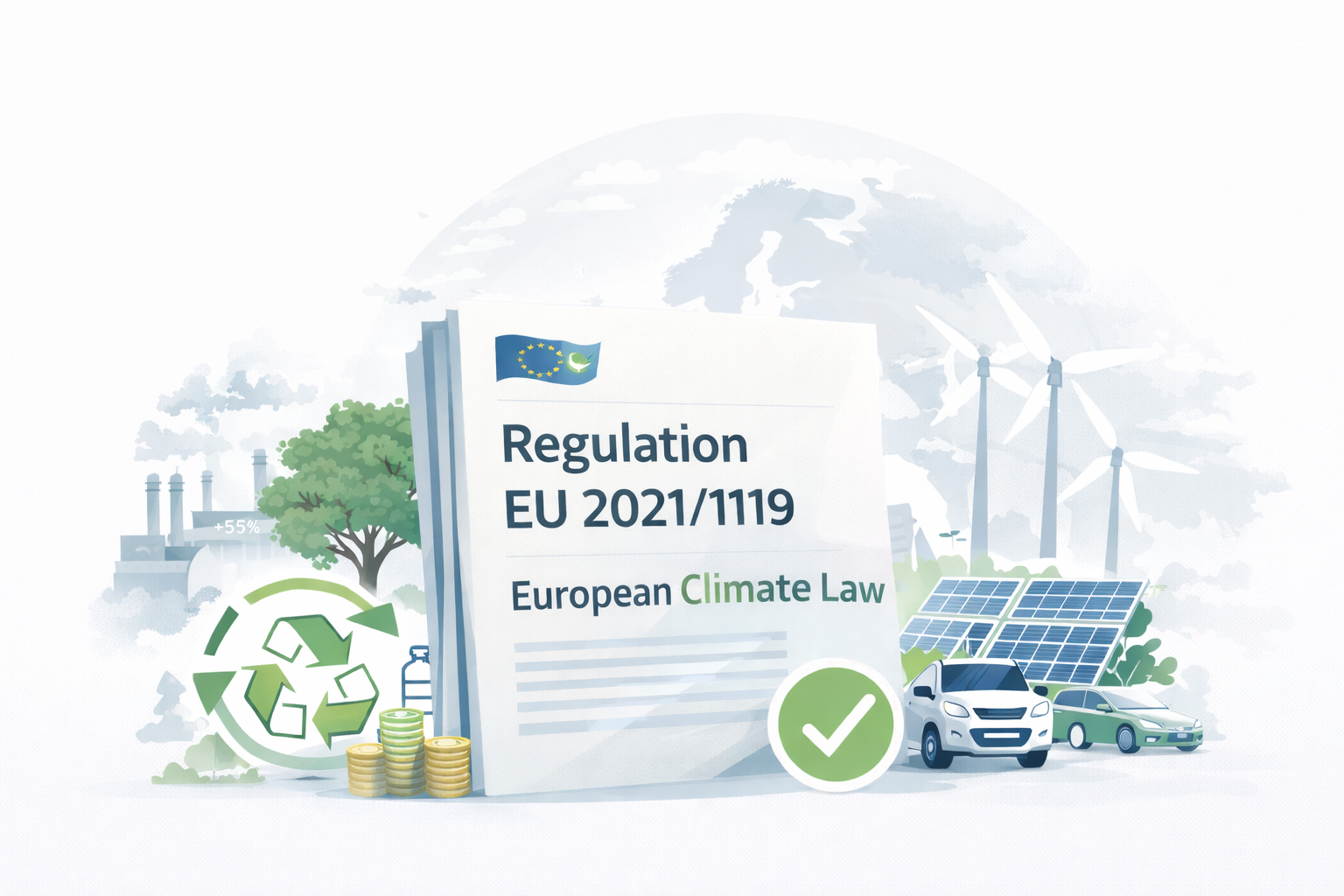 On 30 June 2021, Regulation (EU) 2021/1119 of the European Parliament and of the Council was adopted, establishing a legally binding framework for achieving climate neutrality within the European Union. The Regulation, commonly referred to as the European Climate Law, constitutes a cornerstone of the implementation of the European Green Deal.
Through this act, the European Union, for the first time, transforms its climate objectives from political commitments into binding legal obligations applicable to all Member States and relevant to both the public and private sectors.
What Is the Purpose of the European Climate Law?
The primary objective of Regulation (EU) 2021/1119 is to establish a clear, predictable and long-term framework that:
- ensures the achievement of climate neutrality at EU level by 2050 at the latest;
- provides policy coherence and legal certainty for the development of European and national policies;
- supports businesses, investors and public authorities in long-term strategic planning.
Key Elements of Regulation (EU) 2021/1119
1. Legally Binding Climate Neutrality Objective for 2050
The Regulation introduces a binding obligation for the European Union and its Member States to take the necessary measures to ensure that, by 2050, net greenhouse gas emissions are reduced to zero.
This objective is no longer a strategic aspiration, but a legally established requirement that must be integrated into all relevant policies and actions.
2. Interim Target for 2030
The Regulation establishes an interim target for 2030, requiring at least a 55% net reduction in greenhouse gas emissions compared to 1990 levels.
This interim target is of key importance, as it:
- determines the pace of the transition towards climate neutrality;
- guides future legislative initiatives;
- provides a reference point for investment and business decisions.
3. Policy Coherence and Climate Mainstreaming
The European Climate Law requires that all EU policies, including those related to energy, transport, industry, agriculture and finance, are consistent with the climate neutrality objective.
This means that future regulations and programmes must:
- contribute to greenhouse gas emission reductions;
- avoid undermining long-term climate objectives;
- be assessed from a climate impact perspective.
4. Monitoring, Reporting and Assessment Mechanisms
The Regulation strengthens monitoring and accountability by providing for:
- regular assessment of progress at EU level;
- reliance on scientific evidence and expert analysis;
- the possibility of adopting corrective measures in the event of deviation from the established objectives.
5. Amendments to Existing EU Legislation
Regulation (EU) 2021/1119:
- repeals Regulation (EC) No 401/2009;
- amends Regulation (EU) 2018/1999 on the Governance of the Energy Union and Climate Action,
What Does the European Climate Law Mean for Business?
Although the Regulation is primarily addressed to EU institutions and Member States, its impact on businesses is direct and long-term.
Key implications for companies include:
- the integration of climate objectives into future regulatory requirements;
- the growing importance of emissions management, energy efficiency and sustainability;
- closer links between investment, access to finance and climate-related criteria;
- increased transparency and compliance requirements across supply chains.
Risks and Opportunities
The European Climate Law creates:
- regulatory risks for organisations that fail to adapt in a timely manner;
- economic opportunities for companies that invest in efficiency, innovation and sustainable solutions.
- improved cost management;
- better access to sustainable finance;
- enhanced competitiveness and trust among clients, partners and investors.
Implementation of management standards
CONSEJO Ltd. is a consulting company with over 20 years of practical experience in the development, implementation and maintenance of management systems in accordance with international standards and regulatory requirements. The company provides consulting services in the areas of quality management, environmental management, occupational health and safety, food safety, information security, cybersecurity, risk management and sustainable development. Our expertise covers standards and schemes such as ISO 9001, ISO 14001, ISO 45001, ISO 22000, ISO/IEC 27001, IFS Food, BRCGS and HACCP, as well as consulting services related to NIS2, DORA, GDPR and EcoVadis.
The CONSEJO team has been involved in over 1,500 projects for organizations across various sectors of the economy, including manufacturing, construction, energy, information technology, transport, trade, the food industry and services. Our approach focuses on developing management systems that work effectively in practice, tailored to the specific characteristics and needs of each organization. We work closely with our clients, providing consulting support, staff training and assistance during implementation. We strive to deliver high-quality services within the agreed deadlines and solutions that support successful certification and create long-term value for businesses.


