
The European Green Deal – A Strategic Shift with Direct Implications for Business
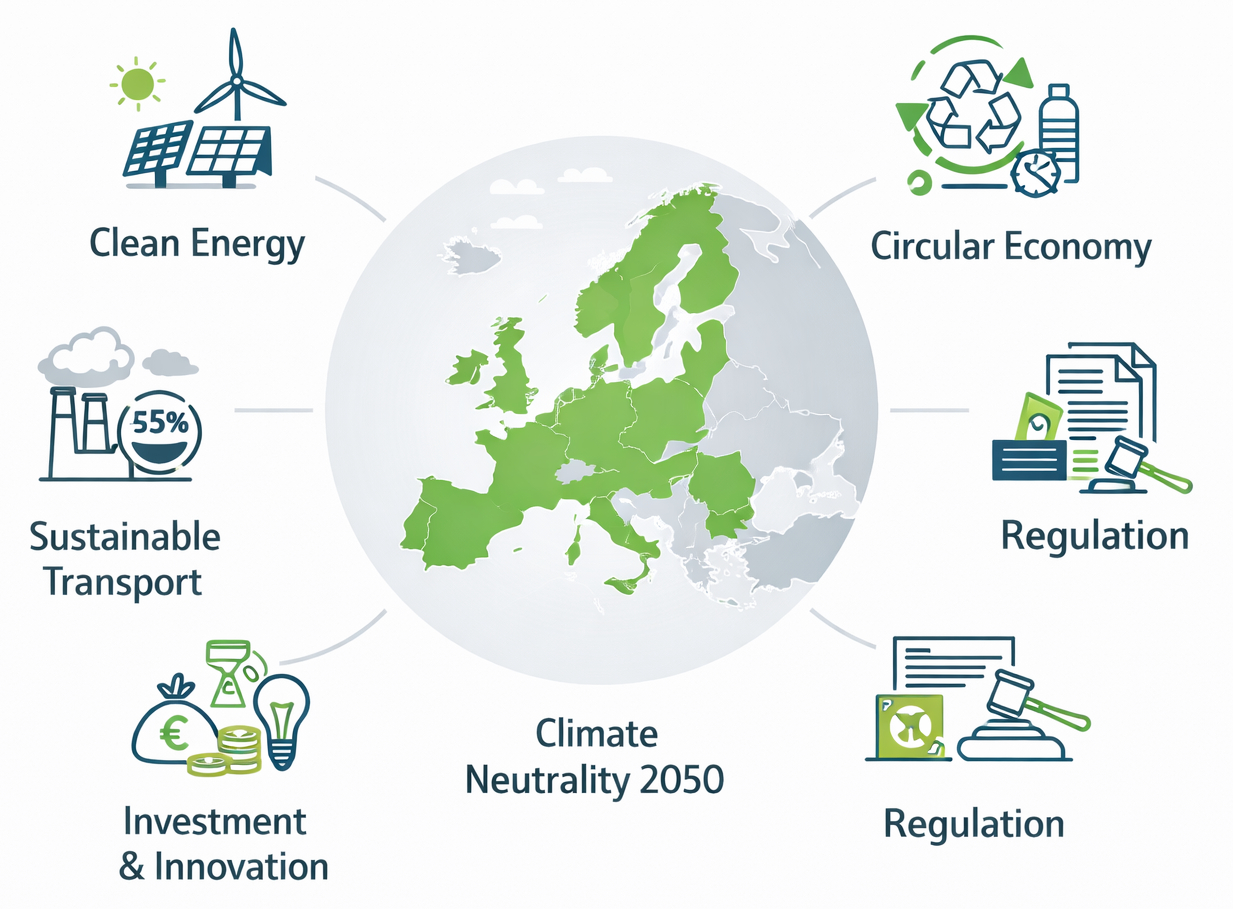 At the end of 2019, the European Commission presented the European Green Deal – a comprehensive strategic framework setting new long-term objectives for the European economy, society, and business. The core ambition of the Green Deal is to make Europe the first climate-neutral continent by 2050, while ensuring economic growth, competitiveness, and social fairness.
For businesses, the Green Deal is not an abstract environmental vision. It defines the future direction of European legislation, financing mechanisms, public procurement, and regulatory requirements affecting companies across all sectors.
What Is the European Green Deal?
The European Green Deal is an overarching strategy for transforming the economy, bringing together policies in the fields of:
- climate and energy,
- industry and innovation,
- transport and logistics,
- circular economy and waste management,
- agriculture and the food supply chain,
- protection of biodiversity and natural resources,
- financing and investment.
The EU’s Main Objectives
Climate Neutrality by 2050
The EU has set the objective of reducing greenhouse gas emissions to a level where any remaining emissions are offset through natural or technological solutions. Achieving this goal requires a profound transformation in the way energy is produced and consumed, as well as in industrial and transport processes.
More Ambitious Interim Targets for 2030
To reach the long-term objective, the European Commission foresees a significant acceleration of action already during the current decade, including a review and strengthening of existing climate and energy legislation.
How Does the Green Deal Affect Business?
1. Energy and Energy Efficiency
Companies will be increasingly encouraged – and in some cases required – to:
- improve the energy efficiency of buildings and equipment;
- optimise energy consumption;
- use renewable energy sources.
2. Carbon Emissions and Risk Management
The Green Deal clearly signals that carbon emissions will increasingly influence the cost of products and services. This affects not only energy-intensive sectors, but also companies throughout the supply chain.
For businesses, this means the need to:
- identify main sources of emissions;
- plan measures to reduce them;
- assess future financial and regulatory risks.
3. Circular Economy
One of the key pillars of the Green Deal is the transition from a linear model (“take – make – dispose”) to a circular economy, where:
- resources are used more efficiently;
- waste generation is reduced;
- products are designed for longer lifespans, reuse, and recycling.
4. Sustainable Transport and Logistics
Transport is among the sectors with the highest contribution to emissions. Within the Green Deal framework, policies are expected to promote:
- cleaner vehicles;
- more efficient logistics;
- the uptake of alternative fuels and technologies.
5. Financing and Sustainable Investment
The Green Deal is closely linked to the development of sustainable finance. An increasing share of public and private funding will be directed towards projects and activities that meet environmental and climate criteria.
For businesses, this means that:
- access to finance will be increasingly linked to sustainability performance;
- transparency and the availability of reliable data will become ever more important.
Risks and Opportunities
The Green Deal creates real risks for companies that fail to adapt, including:
- increased costs;
- regulatory pressure;
- loss of competitiveness.
- innovation and new business models;
- higher efficiency and lower long-term operating costs;
- a stronger position with clients, partners, and financing institutions.
How Consejo Can Support You
Consejo supports organisations in understanding and implementing European policies and regulations related to the Green Deal through:
- analysis of impacts on specific businesses and sectors;
- identification of regulatory and operational risks;
- development of sustainability policies, plans, and measures;
- preparation for future requirements and expectations from clients and institutions.
Implementation of management standards
CONSEJO Ltd. is a consulting company with over 20 years of practical experience in the development, implementation and maintenance of management systems in accordance with international standards and regulatory requirements. The company provides consulting services in the areas of quality management, environmental management, occupational health and safety, food safety, information security, cybersecurity, risk management and sustainable development. Our expertise covers standards and schemes such as ISO 9001, ISO 14001, ISO 45001, ISO 22000, ISO/IEC 27001, IFS Food, BRCGS and HACCP, as well as consulting services related to NIS2, DORA, GDPR and EcoVadis.
The CONSEJO team has been involved in over 1,500 projects for organizations across various sectors of the economy, including manufacturing, construction, energy, information technology, transport, trade, the food industry and services. Our approach focuses on developing management systems that work effectively in practice, tailored to the specific characteristics and needs of each organization. We work closely with our clients, providing consulting support, staff training and assistance during implementation. We strive to deliver high-quality services within the agreed deadlines and solutions that support successful certification and create long-term value for businesses.


