
The Montreal Protocol on Substances that Deplete the Ozone Layer
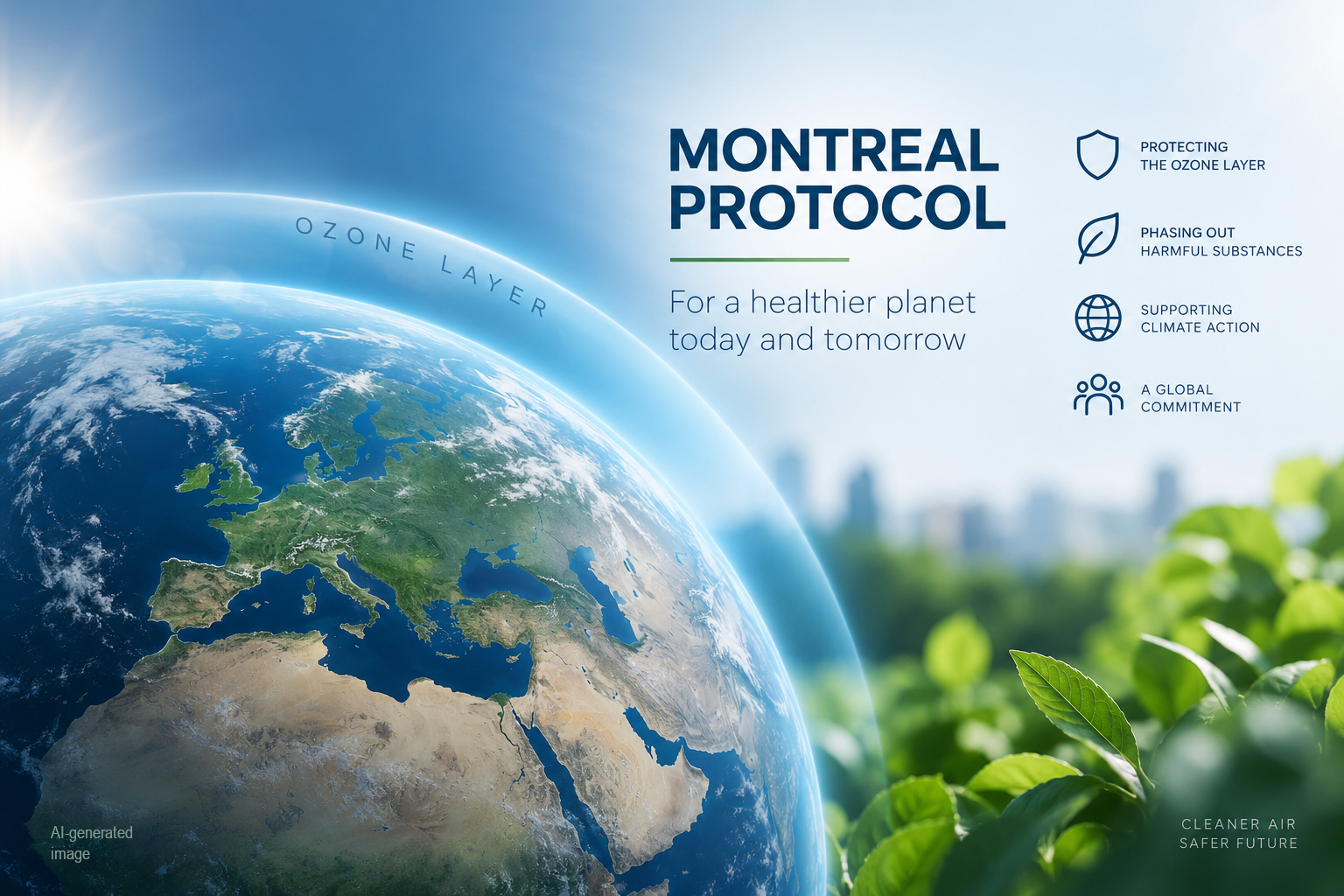 The Montreal Protocol on Substances that Deplete the Ozone Layer is one of the most significant international agreements in the field of environmental protection. Adopted in 1987 and entering into force in 1989, it establishes a global framework for the progressive reduction and phase-out of the production and consumption of substances that damage the stratospheric ozone layer.
The Montreal Protocol has been ratified by all United Nations Member States, making it one of the international agreements with universal participation.
Today, the significance of the Protocol extends beyond its original objective. With the adoption of the Kigali Amendment in 2016, its mechanism was extended to include the gradual phase-down of hydrofluorocarbons (HFCs) – substances that do not deplete the ozone layer but have significant global warming potential.
Why is the Montreal Protocol necessary?
The ozone layer is located in the stratosphere and performs a vital protective function by absorbing a large proportion of the Sun's harmful ultraviolet (UV) radiation.
During the 20th century, the widespread use of certain chemicals in refrigeration and air-conditioning equipment, aerosols, insulation materials, fire protection systems, industrial cleaning and other applications led to significant depletion of the ozone layer. Ozone-depleting substances include chlorofluorocarbons (CFCs), hydrochlorofluorocarbons (HCFCs), halons, methyl bromide, carbon tetrachloride and other controlled substances.
The Montreal Protocol introduces internationally coordinated measures to restrict their production and consumption, with the ultimate objective of gradually phasing them out in accordance with the established schedules and applicable exemptions.
What does the Montreal Protocol regulate?
The Protocol does not impose a one-time ban on specific chemicals. Instead, it establishes a system of control measures that evolves in line with scientific knowledge, technological progress and decisions taken by the Parties to the agreement.
The main mechanisms include:
- controls on the production and consumption of controlled substances;
- gradual reduction and phase-out of different groups of substances;
- controls on trade;
- licensing systems;
- data reporting;
- periodic assessment and review of control measures;
- mechanisms to support developing countries;
- promotion of the development and transfer of alternative technologies.
From ozone-depleting substances to alternative technologies
The transition initiated by the Montreal Protocol has significantly transformed a number of industrial sectors. The gradual phase-out of ozone-depleting substances requires their replacement with alternatives and changes to the technologies, equipment and processes in use.
The refrigeration and air-conditioning sector is particularly important in this respect, as refrigerants are an essential component of these systems.
However, some of the substances introduced as alternatives to ozone-depleting substances present a different environmental challenge. Hydrofluorocarbons (HFCs) do not deplete the ozone layer, but some of them have a very high global warming potential. This issue provided the basis for the next important stage in the development of the Montreal Protocol.
The Kigali Amendment – linking ozone layer protection and climate action
In 2016, the Parties to the Montreal Protocol adopted the Kigali Amendment, bringing hydrofluorocarbons (HFCs) within the framework of the Protocol for the gradual phase-down of their production and consumption.
Unlike CFCs and HCFCs, HFCs are not ozone-depleting substances. However, they are powerful greenhouse gases, some of which have a global warming potential many times greater than that of carbon dioxide. The Kigali Amendment provides for their gradual phase-down according to different schedules for different groups of countries.
In this way, the mechanism established under the Montreal Protocol contributes not only to protecting the ozone layer but also to the transition towards more sustainable solutions in refrigeration and air conditioning.
What does this mean for businesses?
The international commitments under the Montreal Protocol are implemented through specific European and national regulatory requirements. The subject therefore has direct practical relevance for businesses.
In the European Union, the principal legislation governing substances that deplete the ozone layer is Regulation (EU) 2024/590 of the European Parliament and of the Council of 7 February 2024 on substances that deplete the ozone layer, which repeals the previous Regulation (EC) No 1005/2009.
Depending on an organisation's activities, relevant considerations may include the refrigerants used, air-conditioning and refrigeration systems, fire protection systems, technological equipment, servicing and maintenance processes, as well as the management of equipment and substances at the end of their life cycle.
Organisations therefore need to understand the regulatory requirements applicable to their activities, identify the substances and equipment they use, and manage the associated environmental risks and obligations.
The Montreal Protocol and ISO 14001
For organisations that maintain an environmental management system in accordance with ISO 14001, the use of controlled substances and related equipment may form part of the process for identifying environmental aspects and applicable compliance obligations.
 Depending on the organisation's activities, this may include:
- identifying and periodically updating applicable regulatory requirements;
- identifying equipment and substances that fall within the applicable regulatory framework;
- evaluating the associated environmental aspects;
- establishing operational criteria for the operation and maintenance of equipment;
- controlling activities carried out by external service providers;
- preventing and limiting emissions;
- maintaining the necessary documented information and records;
- periodically evaluating compliance with applicable requirements.
The Montreal Protocol is an example of international cooperation in which scientific evidence has been translated into specific and progressively evolving regulatory measures.
Its significance extends beyond restricting the use of certain chemicals. Its implementation has driven changes in technologies, the refrigerants used, equipment design and maintenance, and the management of substances throughout their life cycle.
For businesses, understanding this regulatory framework is important both for ensuring legal compliance and for the systematic management of environmental impacts.
Source: United Nations Environment Programme (UNEP) – Ozone Secretariat
Implementation of management standards
CONSEJO Ltd. is a consulting company with over 20 years of practical experience in the development, implementation and maintenance of management systems in accordance with international standards and regulatory requirements. The company provides consulting services in the areas of quality management, environmental management, occupational health and safety, food safety, information security, cybersecurity, risk management and sustainable development. Our expertise covers standards and schemes such as ISO 9001, ISO 14001, ISO 45001, ISO 22000, ISO/IEC 27001, IFS Food, BRCGS and HACCP, as well as consulting services related to NIS2, DORA, GDPR and EcoVadis.
The CONSEJO team has been involved in over 1,500 projects for organizations across various sectors of the economy, including manufacturing, construction, energy, information technology, transport, trade, the food industry and services. Our approach focuses on developing management systems that work effectively in practice, tailored to the specific characteristics and needs of each organization. We work closely with our clients, providing consulting support, staff training and assistance during implementation. We strive to deliver high-quality services within the agreed deadlines and solutions that support successful certification and create long-term value for businesses.


