
Key Changes in International Standards and Regulatory Requirements in 2025
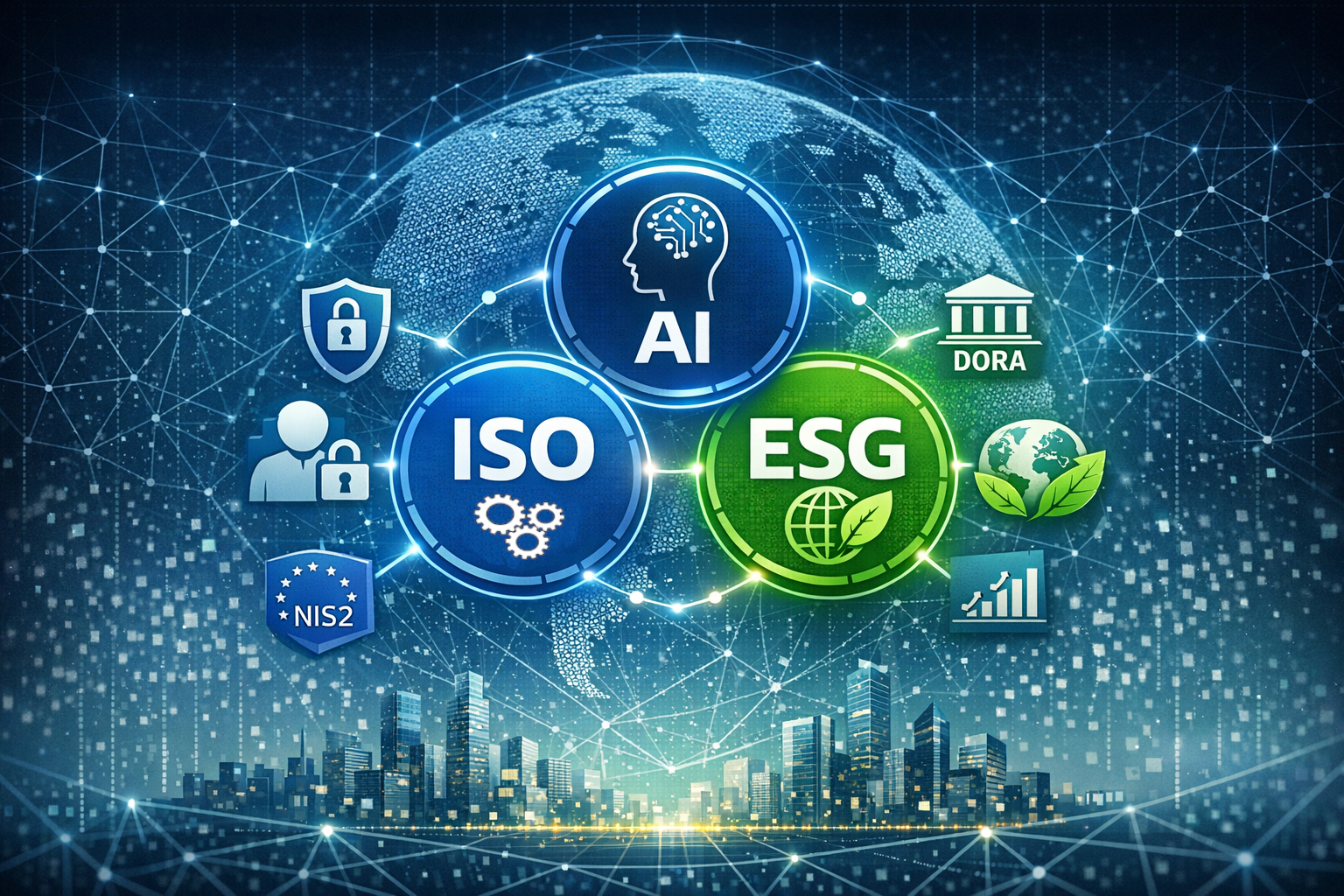 2025 established itself as a year of significant change in the fields of management standards, information security, personal data protection, artificial intelligence, and sustainability.
Across many sectors, the focus gradually shifted from formal compliance toward the practical implementation of effective management systems, integrated into day-to-day organizational processes and supporting the fulfilment of regulatory requirements.
This overview summarizes the key standards, regulatory frameworks, and trends from 2025 that will continue to have an impact in the years ahead.
🔐 Information Security and Personal Data Protection
ISO/IEC 27701:2025 – Privacy Information Management System (PIMS)
In 2025, the revised edition of ISO/IEC 27701 was published, representing an important evolution in the development of the Privacy Information Management System (PIMS) standard.
A key change in the new edition is the ability to implement the standard as a standalone management system, rather than solely as an extension of ISO/IEC 27001. This provides greater flexibility for organizations wishing to structure personal data management independently of a full information security management system.
Guidance and professional analyses related to the revision highlight the following areas:
- clearer differentiation and practical application of the roles of controller and processor;
- stronger linkage between the management of risks to the rights and freedoms of data subjects and actual data processing activities;
- improved traceability between Data Protection Impact Assessments (DPIAs), technical measures, and organizational policies;
- improved structural alignment with ISO/IEC 27001:2022.
ISO/IEC 27018:2025 – Protection of Personal Data in Cloud Environments
ISO/IEC 27018:2025 further reinforced its role as a leading standard for the protection of personal data in public and hybrid cloud environments, particularly in the context of providers acting as personal data processors.
The revised edition is aligned with the structure of controls in ISO/IEC 27002:2022 and reflects the accumulated practical experience of recent years. The standard addresses topics such as:
- transparency regarding roles, sub-processors, and cross-border data transfers;
- control and accountability in the processing of personal data within cloud services;
- clear definition of the responsibilities of cloud service providers acting as data processors.
Relationship Between Standards, NIS 2, DORA, and GDPR
In 2025, it became clear that standards and regulations can no longer be viewed in isolation.
ISO/IEC 27001, ISO/IEC 27701, and ISO/IEC 27018 are increasingly used as an operational framework to support compliance with:
- requirements for risk management, incident handling, and security under Directive (EU) 2022/2555 (NIS 2);
- requirements for operational resilience and ICT controls under Regulation (EU) 2022/2554 (DORA), applicable from 17 January 2025;
- the principles of accountability, security, and personal data protection under the GDPR.
🤖 Artificial Intelligence and New Technological Standards
ISO/IEC 42005:2025 – AI System Impact Assessment
In 2025, ISO/IEC 42005:2025 was published, introducing a structured framework for assessing the impact of artificial intelligence systems on:
- individuals and society;
- organizational processes;
- security, ethics, and risk management;
- the rights and freedoms of affected persons.
Preparation for Systematic AI Governance
In 2025, many organizations began proactive preparations for formalized AI governance, even before the full application of regulatory timelines.
These preparations included:
- development of policies governing the use of AI;
- creation of registers of AI systems;
- procedures for assessment, monitoring, and periodic review;
- integration with risk management and information security frameworks.
📊 Quality Management and Organizational Maturity
Preparation for the Revision of ISO 9001
2025 became a preparatory year for the upcoming revision of ISO 9001, planned for the second half of 2026.
An increasing number of organizations focused on:
- the actual effectiveness of processes;
- the management of risks and opportunities;
- the link between strategy, objectives, and operational activities.
Increased Focus on Processes, Risk, and Stakeholders
Quality is increasingly viewed as an integrated management discipline rather than a standalone system. Integration with information security, sustainability, ESG, and risk management has become a key factor in organizational maturity.
Alongside quality management, 2025 also highlighted the growing need for a systematic approach to integrity, ethics, and compliance.
In the context of heightened regulatory requirements, societal expectations, and increased supply-chain scrutiny, managing the risks of bribery, fraud, and conflicts of interest has become an integral element of organizational maturity.
Ethics, Anti-corruption, and Compliance (ISO 3700x Series – Standards for Anti-bribery, Fraud, and Compliance)
In 2025, several key standards stood out, focusing on integrity management, prevention of misconduct, and the effectiveness of compliance functions:
- ISO 37001:2025 – Anti-bribery management systems: updated requirements and guidance for the prevention, detection, and response to bribery risks;
- ISO 37003:2025 – Guidance for fraud control management systems: structured approaches to fraud prevention, detection, and response;
- ISO 37009:2025 – Guidance on managing conflicts of interest: a practical framework for policies, declarations, controls, and case management.
Alongside ethical and regulatory risk management, organizations increasingly focused in 2025 on improving resource and cost management — particularly energy — as a key component of sustainable management.
Energy Efficiency and Energy Audits (ISO 50002:2025 Series)
In this context, updated parts of the ISO 50002 series were published in 2025, providing a practical framework for a systematic approach to energy audits and the identification of energy-efficiency improvement opportunities:
- ISO 50002-1:2025 – General requirements and framework for conducting energy audits;
- ISO 50002-2:2025 – Specific guidance for energy audits of buildings;
- ISO 50002-3:2025 – Specific guidance for energy audits of processes.
Experience gained in 2025 showed that the management of quality, integrity, risk, and resources is increasingly viewed as the foundation for reliable and verifiable non-financial reporting. This naturally placed greater emphasis on the practical implementation of sustainability and ESG reporting requirements.
🌱 ESG, Sustainability, and Non-financial Reporting
CSRD – First Practical Cycle
2025 marked the first year in which the Corporate Sustainability Reporting Directive (CSRD) moved from concept to practice, with the publication of the first reports for the 2024 reporting year.
Organizations faced:
- the need for reliable and verifiable data;
- coordination across multiple functions and departments;
- the establishment of internal controls and verification mechanisms for non-financial information.
📌 Key Trends from 2025
- Integrated Management Systems
- Increased Requirements for Suppliers
- Growing Role of Training and Internal Awareness
The changes observed in 2025 clearly demonstrated that standards and regulatory frameworks are no longer perceived as formal requirements, but as a foundation for integrated management of risk, technology, resources, and trust. Organizations that succeeded in transforming standards into genuinely operational systems—embedded in daily processes, employee training, and decision-making—achieved higher levels of resilience and preparedness for future regulatory and market challenges. In this sense, 2025 can be regarded as a turning point, where managerial maturity—rather than formal compliance—emerged as a key driver of long-term success.
Implementation of management standards
CONSEJO Ltd. is a consulting company with over 20 years of practical experience in the development, implementation and maintenance of management systems in accordance with international standards and regulatory requirements. The company provides consulting services in the areas of quality management, environmental management, occupational health and safety, food safety, information security, cybersecurity, risk management and sustainable development. Our expertise covers standards and schemes such as ISO 9001, ISO 14001, ISO 45001, ISO 22000, ISO/IEC 27001, IFS Food, BRCGS and HACCP, as well as consulting services related to NIS2, DORA, GDPR and EcoVadis.
The CONSEJO team has been involved in over 1,500 projects for organizations across various sectors of the economy, including manufacturing, construction, energy, information technology, transport, trade, the food industry and services. Our approach focuses on developing management systems that work effectively in practice, tailored to the specific characteristics and needs of each organization. We work closely with our clients, providing consulting support, staff training and assistance during implementation. We strive to deliver high-quality services within the agreed deadlines and solutions that support successful certification and create long-term value for businesses.


