
ISO 14092:2026 – Standard for Climate Change Adaptation Planning
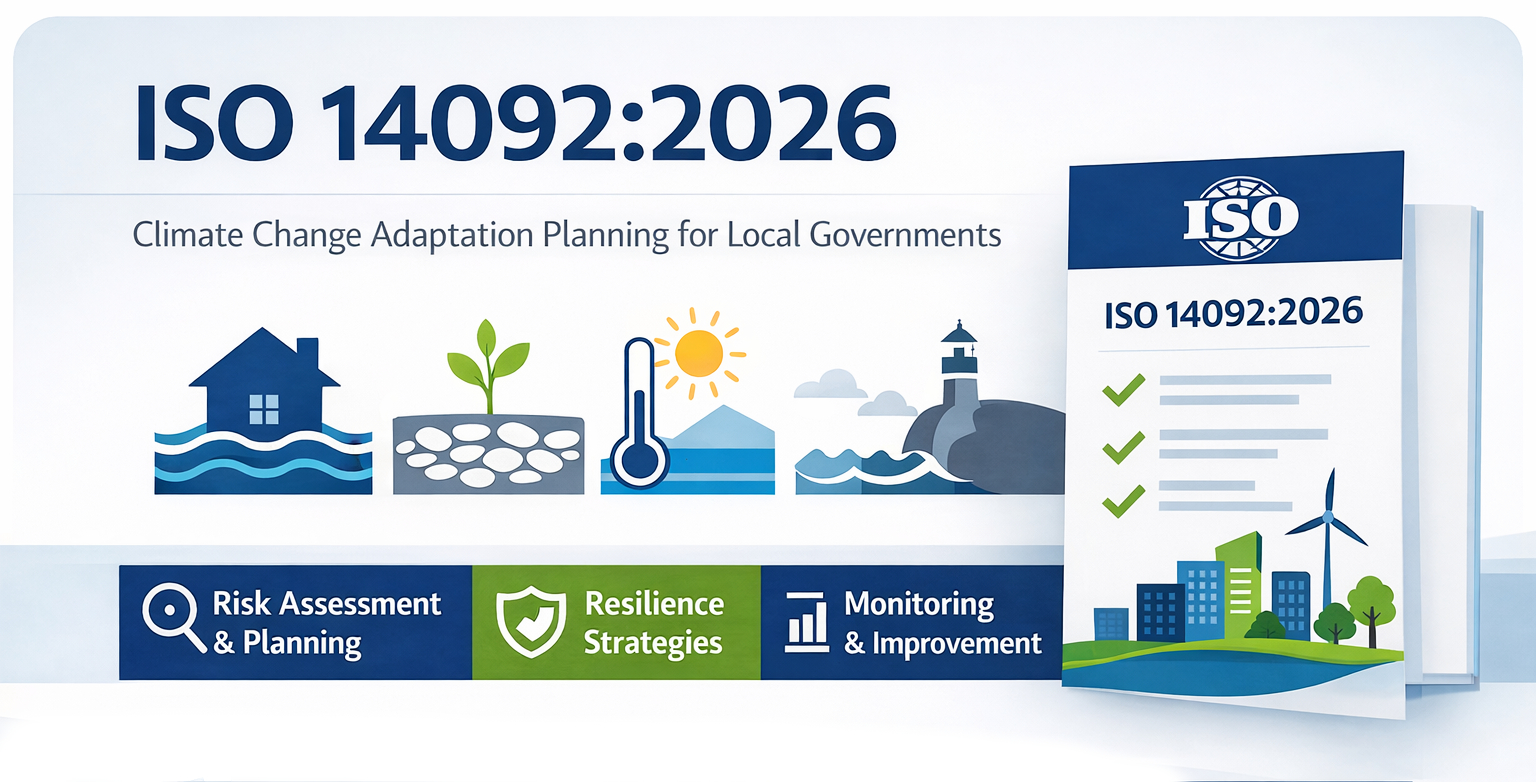
The new edition introduces updated requirements and guidance for climate change adaptation planning at the level of local governments and communities and represents the evolution of the previous technical specification, ISO/TS 14092:2020.
ISO 14092:2026 specifies requirements and provides guidance to support local authorities and communities in developing robust, evidence-based adaptation plans. The standard supports decision-making at the level where climate impacts — such as floods, droughts, heatwaves and coastal erosion — are directly experienced, through a structured, step-by-step process for planning, implementing, monitoring and updating adaptation measures.
The 2026 edition includes revised guidance reflecting the evolving climate context, as well as a new Annex D providing additional guidance on the implementation of adaptation measures. The standard is developed in accordance with the framework of ISO 14090, ISO 14091 and ISO 14093, which together form a coherent framework for climate risk management and financing of adaptation actions.
ISO 14092:2026 specifies requirements and provides guidance on adaptation planning for local governments and communities.
The standard:
- supports adaptation based on vulnerability, impact and risk assessments;
- supports the setting of priorities and the development, implementation and updating of an adaptation plan;
- promotes the active involvement of relevant interested parties throughout the planning process.
Relationship with Other Standards in the ISO 14000 Series
ISO 14092 is designed in accordance with the logical framework of ISO 14090:2019 and is closely related to the following standards:
- ISO 14090 – provides principles, requirements and guidelines for adaptation to climate change at the organizational level;
- ISO 14091 – provides guidelines on vulnerability, impacts and climate change risk assessment;
- ISO 14093 – establishes an approach and methodology for a country-based mechanism to channel climate finance to subnational authorities through performance-based climate resilience grants (PBCRGs), in support of climate change adaptation and resilience.
Structure of ISO 14092:2026
The standard is structured as a sequential process for adaptation planning at the local government and community level.
Clause 4 defines the principles of adaptation planning, including accountability, continuous learning and improvement, flexibility, mainstreaming and embedding, practicality, prioritization, proportionality, relevance and transparency.
Clause 5 addresses pre-planning activities, including framing adaptation within the specific context and defining roles and responsibilities.
Clause 6 covers the assessment of climate change risks and opportunities, including:
- identifying climate change trends and scenarios;
- analysing climate change impacts;
- applying climate risk assessment methods;
- assessing adaptive capacity;
- identifying opportunities;
- addressing uncertainties.
Clause 8 addresses implementation requirements, including leadership and commitment, preparation for implementation and development of an implementation plan.
Clauses 9 and 10 cover monitoring and evaluation, reporting and communication.
The standard includes four annexes:
- Annex A – example tables of contents of local adaptation plans;
- Annex B – tools for local adaptation planning (including internationally recognized methodologies);
- Annex C – indicators for monitoring and evaluation;
- Annex D – informative guidelines on climate change adaptation, newly added in the 2026 edition.
Why ISO 14092 Matters
The impacts of climate change are no longer a future concern — they are already occurring. From infrastructure damage to water scarcity, climate risks are affecting services, assets and communities. ISO 14092 supports the translation of climate science and risk data into concrete local action, promoting resilience through adaptive governance, strategic planning and continuous improvement.
In a context of increasing regulatory requirements and financial pressure to address climate change, the standard provides a reliable tool for:
- understanding how climate risks affect a specific region or operations;
- collaborating with relevant interested parties in planning adaptation measures;
- aligning with global frameworks such as the Paris Agreement and the United Nations Sustainable Development Goals (SDGs).
Benefits for Organizations
- Provides a structured, step-by-step approach for developing and updating local adaptation plans;
- Integrates with other climate standards within the ISO 14000 series;
- Supports decision-making through processes tailored to specific regional contexts and risks;
- Promotes continuous improvement through monitoring and periodic review;
- Aligns with global climate frameworks while remaining adaptable to national and local contexts.
Applicability
Although the standard is primarily intended for local governments and communities, it can also be applied by organizations that:
- manage assets within a defined geographical context;
- are exposed to regional climate risks;
- develop adaptation plans in coordination with relevant interested parties.
ISO 14092:2026 consolidates structured requirements and guidance for planning and managing climate change adaptation at the local level.
With the publication of ISO 14092:2026, the international standardization framework for local climate change adaptation is further reinforced. The new edition replaces ISO/TS 14092:2020 and reflects the growing need for systematic, risk-based and evidence-informed planning of community climate resilience.
Implementation of management standards
CONSEJO Ltd. is a consulting company with over 20 years of practical experience in the development, implementation and maintenance of management systems in accordance with international standards and regulatory requirements. The company provides consulting services in the areas of quality management, environmental management, occupational health and safety, food safety, information security, cybersecurity, risk management and sustainable development. Our expertise covers standards and schemes such as ISO 9001, ISO 14001, ISO 45001, ISO 22000, ISO/IEC 27001, IFS Food, BRCGS and HACCP, as well as consulting services related to NIS2, DORA, GDPR and EcoVadis.
The CONSEJO team has been involved in over 1,500 projects for organizations across various sectors of the economy, including manufacturing, construction, energy, information technology, transport, trade, the food industry and services. Our approach focuses on developing management systems that work effectively in practice, tailored to the specific characteristics and needs of each organization. We work closely with our clients, providing consulting support, staff training and assistance during implementation. We strive to deliver high-quality services within the agreed deadlines and solutions that support successful certification and create long-term value for businesses.


