
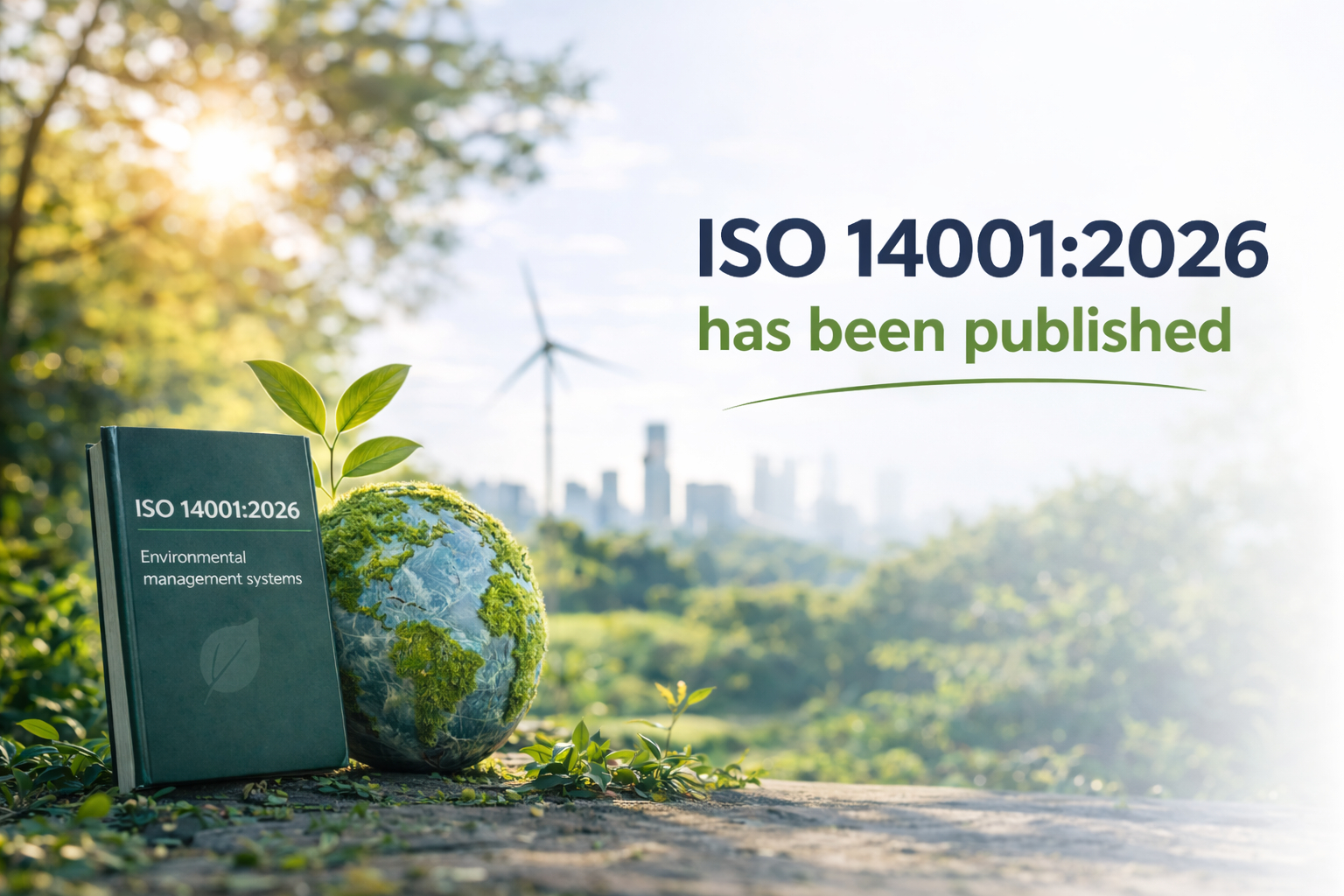
ISO 14001:2026 has been published
 What's new in the 2026 edition?
The key changes in ISO 14001:2026 are aimed at improving the clarity, consistency and applicability of the standard, while preserving its established structure and principles. They can be summarised under the following key areas:
1. Alignment with the requirements for management system standards (HLS)
The standard has been aligned with ISO's latest requirements for management system standards, including the ISO Harmonized Structure (HLS) for management system standards, incorporating the common core text and unified definitions. This facilitates integration with other standards such as ISO 9001 and ISO 45001.
2. Greater clarity and precision of requirements
Requirements have been refined to enable more unambiguous interpretation and application. Particular attention has been given to topics such as the life cycle perspective, internal and external communication, and the role of top management.
3. Strengthened focus on environmental performance
The standard reinforces the need for organisations to plan, monitor and evaluate the effectiveness of the environmental management system, as well as the environmental performance achieved, in a structured and measurable manner — maintaining the link between processes, risks and outcomes.
4. Better reflection of the contemporary environmental context
The standard acknowledges the evolution of global environmental challenges and rising expectations placed on organisations, including those relating to climate change, resource efficiency, waste management and ecosystem protection. These aspects have been integrated into the analysis of the organisation's context and the management of risks and opportunities.
5. Improved compatibility with other management systems
ISO 14001:2026 is designed to support the establishment and maintenance of integrated management systems through a common risk-based approach and alignment with other international standards.
The standard retains the well-established Plan–Do–Check–Act (PDCA) model as the basis for the iterative process of continual improvement, applicable to the system as a whole and to each of its elements.
Why does this matter now?
Organisations today face mounting pressure from regulatory bodies, customers, investors and supply chains to demonstrate real and measurable environmental action. Climate change, biodiversity loss, inefficient use of resources and inadequate waste management now carry not only environmental, but also financial and reputational consequences.
ISO 14001:2026 provides organisations with a structured response to these challenges: a framework for environmental protection, risk management and compliance with legal requirements — in balance with business objectives. ISO 14001 remains a key instrument for sustainable management.
Who does the standard apply to?
The standard is applicable to any organisation — regardless of size, sector or type of activity — including construction companies, manufacturing enterprises, transport and logistics, energy, food and beverage, healthcare and the public sector.
Key benefits of implementation
Implementing ISO 14001:2026 can contribute to:
- improved and measurable environmental performance
- enhanced compliance with environmental legislation
- reduction of waste and optimisation of resource use
- operational cost savings
- improved management of environmental risks
- strengthened confidence and trust from customers and partners
What's next for certified organisations?
Organisations already certified to ISO 14001:2015 will need to transition to the new edition within the transition period, which is yet to be officially announced by accreditation and certification bodies. We recommend not waiting until the last moment — a timely gap analysis and a planned transition saves both resources and risk.
How can CONSEJO help?
CONSEJO supports organisations at every stage of the implementation, transition and maintenance of ISO 14001:
- gap analysis against the current state
- transition to the new version of the EMS
- personnel training
- conducting internal audits
- preparation for certification
Contact us for a consultation on the implementation of and transition to ISO 14001:2026.
Implementation of management standards
CONSEJO Ltd. is a consulting company with over 20 years of practical experience in the development, implementation and maintenance of management systems in accordance with international standards and regulatory requirements. The company provides consulting services in the areas of quality management, environmental management, occupational health and safety, food safety, information security, cybersecurity, risk management and sustainable development. Our expertise covers standards and schemes such as ISO 9001, ISO 14001, ISO 45001, ISO 22000, ISO/IEC 27001, IFS Food, BRCGS and HACCP, as well as consulting services related to NIS2, DORA, GDPR and EcoVadis.
The CONSEJO team has been involved in over 1,500 projects for organizations across various sectors of the economy, including manufacturing, construction, energy, information technology, transport, trade, the food industry and services. Our approach focuses on developing management systems that work effectively in practice, tailored to the specific characteristics and needs of each organization. We work closely with our clients, providing consulting support, staff training and assistance during implementation. We strive to deliver high-quality services within the agreed deadlines and solutions that support successful certification and create long-term value for businesses.


