
ISO 14001:2026 – What to Expect from the New Version
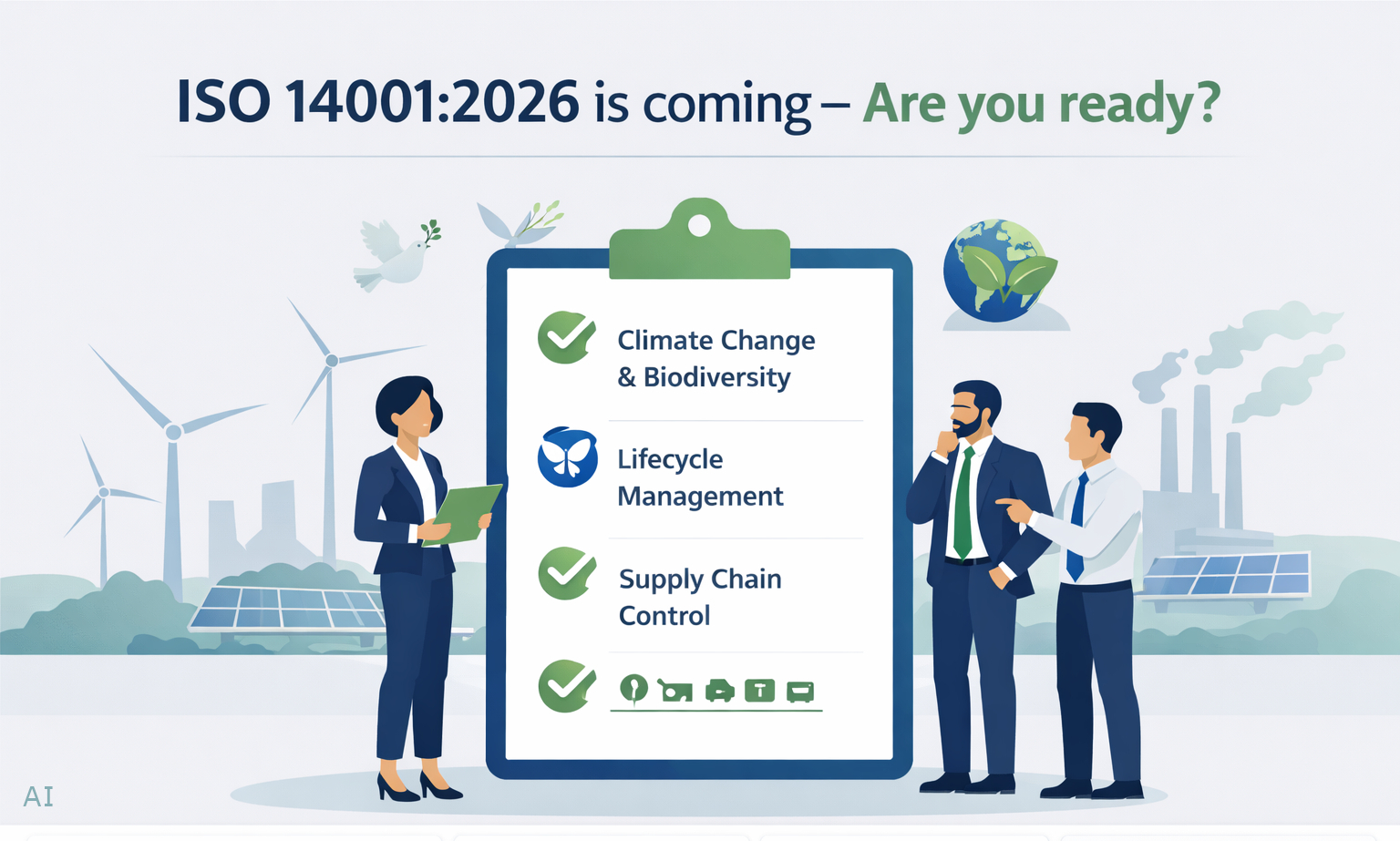 In April 2026, the official publication of the new version of the international standard ISO 14001:2026 is expected. It will reflect the evolving global requirements for environmental management, sustainability, and corporate responsibility.
What is ISO 14001?
ISO 14001 is a leading international standard for environmental management systems (EMS). It provides a framework that enables organizations to identify, control, and improve their environmental impact while ensuring compliance with regulatory requirements and enhancing their overall performance.
The standard is applicable to organizations of all sizes and sectors and is widely recognized as a foundation for sustainable management and development.
Why is the standard being updated?
The revision of ISO 14001 is part of the regular review process for ISO standards, aimed at ensuring their continued relevance and applicability. The new version reflects key global trends such as:
- increased focus on climate change
- biodiversity loss
- pressure from regulators, investors, and stakeholders
- the need for better integration between different management systems
What is changing?
The changes in ISO 14001:2026 are aimed at better addressing contemporary environmental challenges. The new version places greater emphasis on global issues such as climate change, biodiversity, and the sustainable use of natural resources, which will need to be integrated into the organizational context and strategic planning.
At the same time, the life cycle approach is strengthened, requiring clearer identification and evaluation of the impacts of products and services throughout their entire lifecycle. A more structured approach to change management is introduced, along with greater control over externally provided processes, products, and services, placing higher demands on supply chain management.
In addition, part of the update focuses on improving the clarity of requirements and facilitating practical implementation.
What remains unchanged?
ISO 14001:2026 retains the “Annex SL” structure (High-Level Structure), ensuring a high level of compatibility and facilitating integration with other management system standards such as ISO 9001 (quality management) and ISO 45001 (occupational health and safety).
This unified approach enables better consistency in planning and conducting internal and external audits, as well as more effective process management. It supports organizations in managing risk, compliance, and continuous improvement, while also helping achieve strategic objectives related to sustainability and operational efficiency.
What does this mean for businesses?
ISO 14001:2026 reflects the transition from traditional environmental compliance to a broader approach that includes sustainability, risk management, and strategic planning.
The new version will help organizations to:
- integrate environmental considerations into business decisions
- improve transparency and accountability
- respond to growing ESG requirements
- enhance stakeholder trust
The upcoming release of ISO 14001:2026 marks an important step in the development of international environmental management standards. Although the changes are not radical, they clearly point toward more sustainable, integrated, and strategically oriented management.
Implementation of management standards
CONSEJO Ltd. is a consulting company with over 20 years of practical experience in the development, implementation and maintenance of management systems in accordance with international standards and regulatory requirements. The company provides consulting services in the areas of quality management, environmental management, occupational health and safety, food safety, information security, cybersecurity, risk management and sustainable development. Our expertise covers standards and schemes such as ISO 9001, ISO 14001, ISO 45001, ISO 22000, ISO/IEC 27001, IFS Food, BRCGS and HACCP, as well as consulting services related to NIS2, DORA, GDPR and EcoVadis.
The CONSEJO team has been involved in over 1,500 projects for organizations across various sectors of the economy, including manufacturing, construction, energy, information technology, transport, trade, the food industry and services. Our approach focuses on developing management systems that work effectively in practice, tailored to the specific characteristics and needs of each organization. We work closely with our clients, providing consulting support, staff training and assistance during implementation. We strive to deliver high-quality services within the agreed deadlines and solutions that support successful certification and create long-term value for businesses.


