
Information Security and Cybersecurity – Is There a Difference?
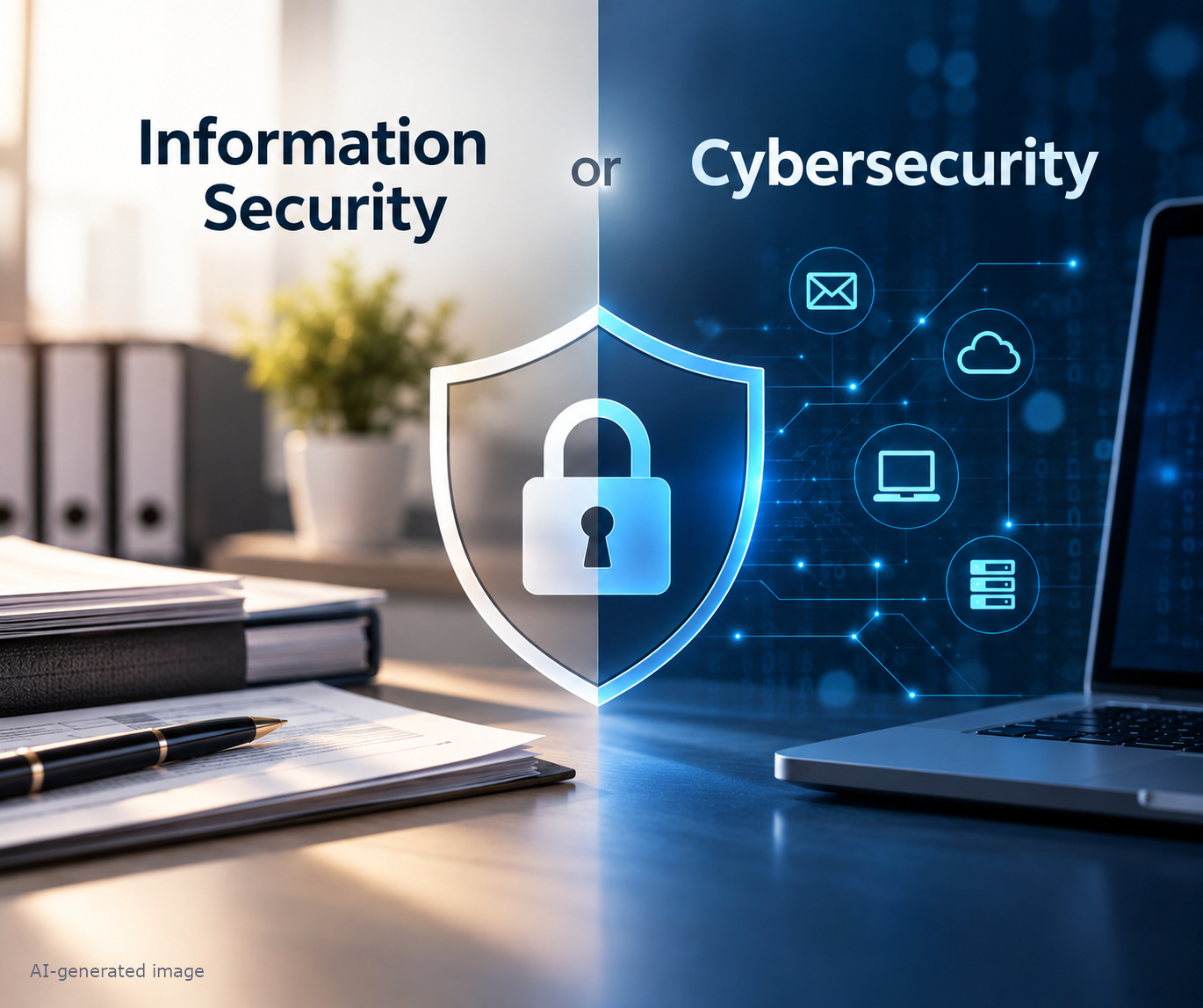 The digitalization of business processes, the use of cloud services, remote working, and the growing volume of information that organizations create and process have made security an important management priority.
In this context, the terms “cybersecurity” and “information security” are often used interchangeably. They are closely related, but they are not entirely the same. Understanding the distinction helps organizations determine more precisely what they need to protect, what risks they need to address, and what measures they should implement.
What Is Information Security?
Information security focuses on protecting information, regardless of the form in which it exists or the environment in which it is stored, processed, or transmitted.
This means that the information requiring protection may include not only electronic data and information systems, but also paper documents, contracts, technical documentation, meeting records, information exchanged verbally, and other forms of information that have value to the organization.
Information security is traditionally based on three key properties:
- confidentiality – ensuring that information is accessible only to those authorized to access it;
- integrity – safeguarding the accuracy and completeness of information;
- availability – ensuring that information and related resources are accessible when needed.
What Is Cybersecurity?
Cybersecurity focuses on protection in the digital environment and against threats that arise within it.
Under the European Cybersecurity Act – Regulation (EU) 2019/881, cybersecurity encompasses the activities necessary to protect network and information systems, their users, and other persons affected by cyber threats. A cyber threat, in turn, relates to potential circumstances, events, or actions that could damage, disrupt, or otherwise adversely affect such systems, their users, and other persons.
In practice, cybersecurity measures may address threats such as:
- phishing and other forms of social engineering;
- malware and ransomware;
- unauthorized access to systems and accounts;
- attacks against networks and information systems;
- compromised user credentials;
- exploitation of vulnerabilities in software, systems, and devices.
What Is the Difference in Practice?
The distinction is easiest to understand through practical examples.
If a confidential paper contract is left in a place accessible to unauthorized persons, this creates an information security risk, even though no information system has been affected and no cyberattack has taken place.
If an employee receives a phishing message, discloses their credentials, and those credentials are subsequently used to gain unauthorized access to a corporate system, the incident clearly has a cybersecurity dimension. At the same time, it may affect the confidentiality, integrity, or availability of information.
The loss of a company laptop is another example. It involves the physical loss of an asset, but if the device contains sensitive information or provides access to corporate systems, the consequences may affect both information security and cybersecurity.
These examples illustrate why there is significant overlap between the two areas in practice and why it is not always useful to consider the associated risks in isolation.
Information Security Is Not Just the Responsibility of the IT Department
One common misconception is that information security is primarily a technical matter.
Antivirus software, firewalls, multi-factor authentication, backups, and other technical solutions are important, but they cannot, on their own, ensure effective information security management.
Organizations also need to consider questions such as:
- Which information is critical to the organization’s operations?
- Who has access to it and on what basis?
- How are access rights granted, changed, and revoked?
- How do employees recognize and report incidents and suspicious events?
- How are risks associated with external suppliers managed?
- What happens if information is lost or a critical system becomes unavailable?
- How is information protected outside the digital environment?
- How does the organization verify that the measures implemented remain effective?
Where Does ISO/IEC 27001 Fit In?
ISO/IEC 27001:2022 is the international standard that specifies the requirements for an information security management system (ISMS).
It provides a framework for systematically identifying, assessing, and treating information security risks. The approach is not limited to a particular technology or type of cyber threat. It integrates information security into the organization’s processes and management practices and addresses the interaction between people, processes, and technology.
Cybersecurity and Information Security – Different Concepts, a Shared Objective
The distinction between cybersecurity and information security matters, but for organizations, the more important question is whether risks are being managed consistently and systematically.
Cyber threats are a significant part of today’s risk environment, but information can also be compromised in many other ways – through human error, inappropriate access rights, physical loss, inadequate supplier management, or the absence of appropriate organizational rules.
Effective protection therefore does not begin with choosing a particular technology. It begins with understanding which information is important to the organization, what risks threaten it, and how those risks should be managed.
This systematic, risk-based approach lies at the heart of information security management under ISO/IEC 27001.
Implementation of management standards
CONSEJO Ltd. is a consulting company with over 20 years of practical experience in the development, implementation and maintenance of management systems in accordance with international standards and regulatory requirements. The company provides consulting services in the areas of quality management, environmental management, occupational health and safety, food safety, information security, cybersecurity, risk management and sustainable development. Our expertise covers standards and schemes such as ISO 9001, ISO 14001, ISO 45001, ISO 22000, ISO/IEC 27001, IFS Food, BRCGS and HACCP, as well as consulting services related to NIS2, DORA, GDPR and EcoVadis.
The CONSEJO team has been involved in over 1,500 projects for organizations across various sectors of the economy, including manufacturing, construction, energy, information technology, transport, trade, the food industry and services. Our approach focuses on developing management systems that work effectively in practice, tailored to the specific characteristics and needs of each organization. We work closely with our clients, providing consulting support, staff training and assistance during implementation. We strive to deliver high-quality services within the agreed deadlines and solutions that support successful certification and create long-term value for businesses.


