
Action Plan Against Cyberbullying

On 10 February 2026, on the occasion of Safer Internet Day, the European Commission presented the EU Action Plan Against Cyberbullying – a package of measures aimed at protecting the mental health and well-being of children and young people in the digital environment. The Plan sets out a coordinated approach to preventing and addressing cyberbullying online.
The Plan responds to alarming data on the scale of the problem among minors: according to information from the Commission, approximately 1 in 6 children aged 11–15 report having been victims of cyberbullying, while around 1 in 8 admit to having engaged in such behaviour.
Cyberbullying is no longer a “marginal” risk but a serious and widespread issue in the digital environment, affecting:
- mental health and school integration and performance;
- the sense of safety in online spaces;
- the ability of institutions to respond quickly and in a coordinated manner, particularly where content and platforms operate across borders.
The Plan forms part of broader EU efforts such as the Better Internet for Kids (BIK+) strategy and measures under the Digital Services Act (DSA) to enhance children’s online safety. It complements existing tools and policies.
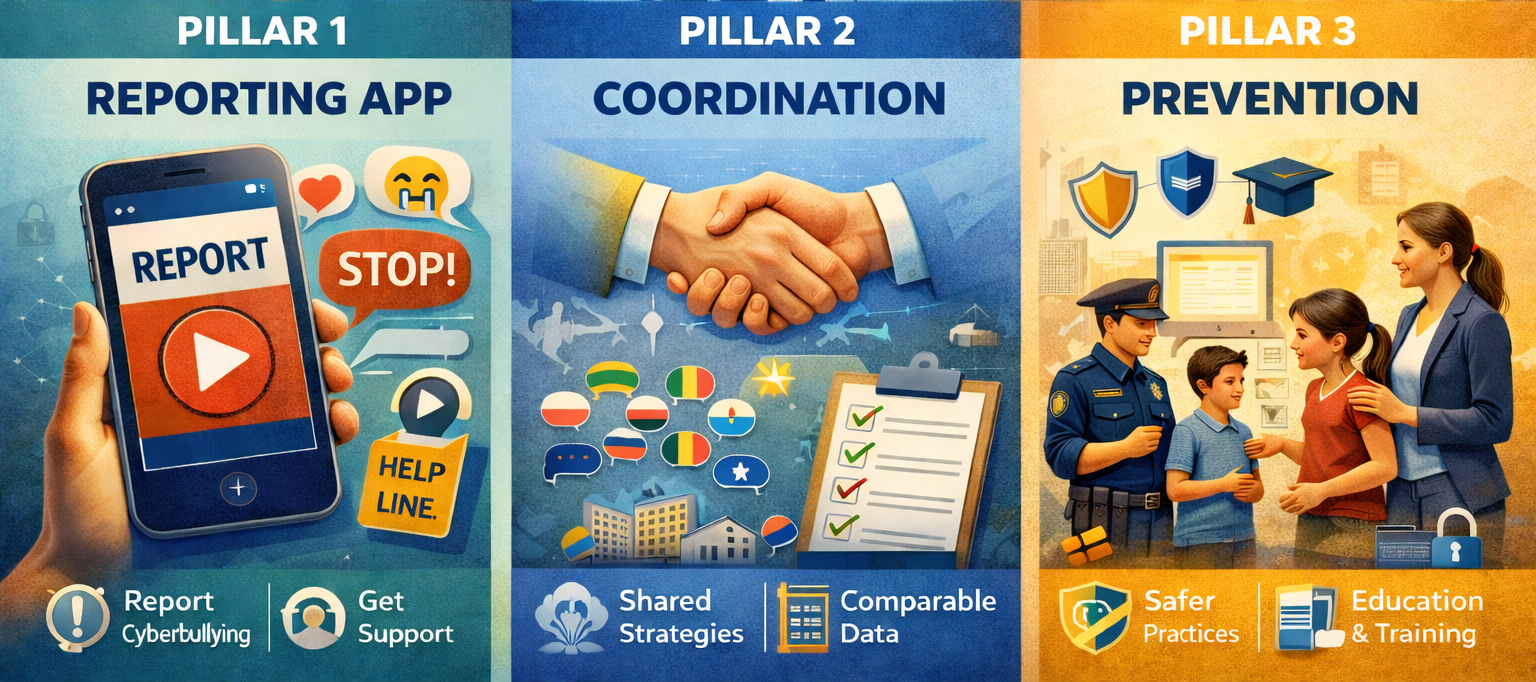
Pillar 1: EU-wide reporting application and real support
The most concrete measure under the Plan is the creation of an EU-wide application (app) that will enable victims to:
- report cases of cyberbullying in an easy and accessible manner;
- receive support and guidance to national helplines and services;
- securely store evidence of abuse (e.g. screenshots, links, contextual information) that may be used in further action.
 Pillar 2: Coordination among Member States and a common approach
The second pillar focuses on improving coordination of national policies in order to avoid significant differences in approaches and definitions across Member States.
The Plan encourages Member States to:
- develop national strategies to combat cyberbullying;
- adopt a common definition and compatible approaches for collecting and comparing data;
- strengthen coordination among institutions and relevant stakeholders.
In practice, shared concepts and comparable data enable more accurate evaluation of the effectiveness of various measures — such as school programmes, awareness campaigns, helplines and reporting procedures — and facilitate the scaling up of proven successful models.
Pillar 3: Prevention through safer digital practices and education
The third pillar focuses on prevention by:
- promoting safer and more responsible digital practices from an early age;
- improving resources, training and support for teachers, parents, schools and young people.
Expectations for Online Platforms and the Sensitivity of the Issue
Although the Plan is primarily focused on supporting victims and improving national coordination, public discussions suggest that the European Commission is also addressing the role of online platforms. Platforms are expected to strengthen measures to prevent harmful content and facilitate reporting mechanisms, including through more rigorous enforcement and further refinement of existing requirements under the Digital Services Act concerning the protection of minors.
The role of platforms remains a sensitive issue, as it requires a careful balance between reactive notice-and-action mechanisms and more structured safety-by-design approaches.
What This Means for Organisations
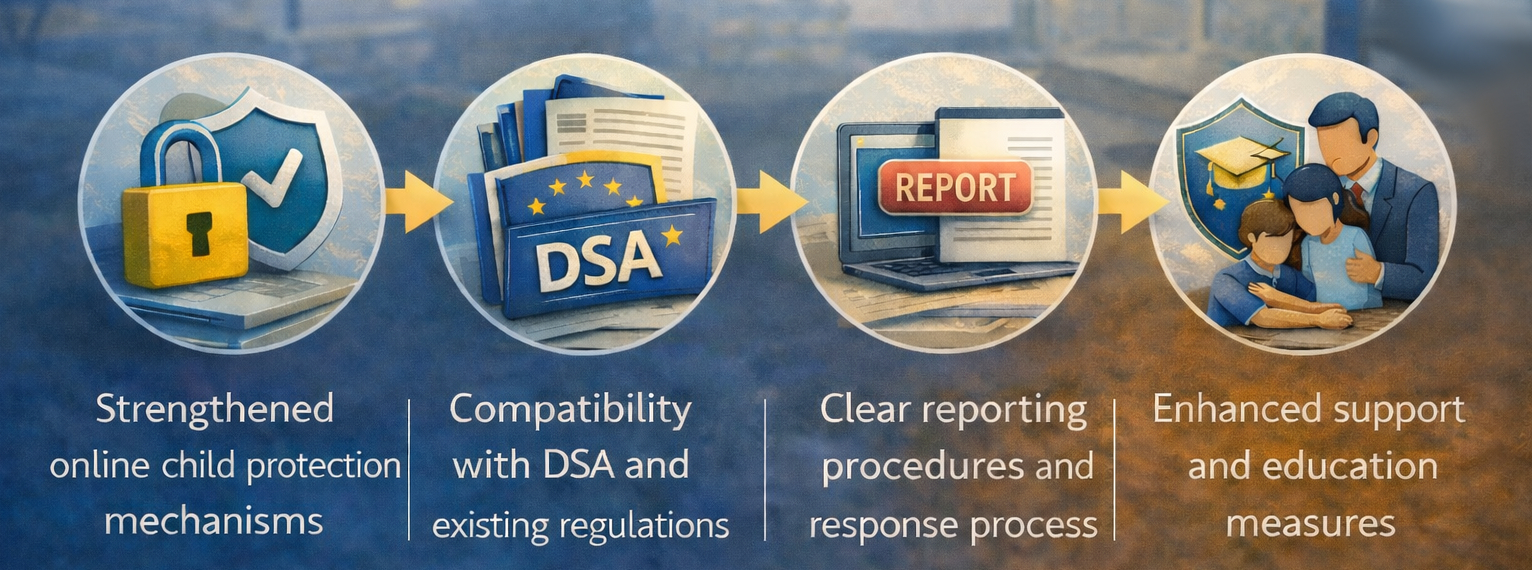
Organisations that provide online services to children or process minors’ data should expect:
- Increased scrutiny of mechanisms for protecting minors online.
- The need to ensure compliance with the DSA and other existing regulatory requirements.
- Clear internal procedures for reporting and responding to cases of cyberbullying.
- Greater attention to the effectiveness of user protection and safety measures.
The Plan places greater emphasis on coordination and prevention rather than introducing new specific regulatory obligations.
Strengths
- A single point of access to assistance (application + evidence storage + referral to services).
- Improved data comparability across Member States (if the common approach is consistently applied).
- Stronger emphasis on prevention through education, rather than solely reactive measures.
Possible risks organisations may face in implementing the Plan include:
- limited capacity to respond to cyberbullying reports;
- the need to ensure adequate data protection and confidentiality when handling sensitive information;
- potential societal, legal and reputational consequences arising from improper case management.
The Action Plan Against Cyberbullying strengthens the European focus on protecting children in the digital environment and sets clearer expectations for institutions, platforms and organisations. At this stage, the Plan does not introduce standalone new legislative obligations but emphasises more consistent enforcement of the existing regulatory framework, including under the Digital Services Act.
For organisations developing digital services — particularly those aimed at children and young people — the Plan should be viewed as a signal of increased regulatory and public scrutiny regarding the management of online risks. A proactive approach to safety by design and effective reporting mechanisms may serve not only as a compliance tool but also as a competitive advantage.
Implementation of management standards
CONSEJO Ltd. is a consulting company with over 20 years of practical experience in the development, implementation and maintenance of management systems in accordance with international standards and regulatory requirements. The company provides consulting services in the areas of quality management, environmental management, occupational health and safety, food safety, information security, cybersecurity, risk management and sustainable development. Our expertise covers standards and schemes such as ISO 9001, ISO 14001, ISO 45001, ISO 22000, ISO/IEC 27001, IFS Food, BRCGS and HACCP, as well as consulting services related to NIS2, DORA, GDPR and EcoVadis.
The CONSEJO team has been involved in over 1,500 projects for organizations across various sectors of the economy, including manufacturing, construction, energy, information technology, transport, trade, the food industry and services. Our approach focuses on developing management systems that work effectively in practice, tailored to the specific characteristics and needs of each organization. We work closely with our clients, providing consulting support, staff training and assistance during implementation. We strive to deliver high-quality services within the agreed deadlines and solutions that support successful certification and create long-term value for businesses.


