
EN 13432: The European Standard for Compostability and Biodegradability
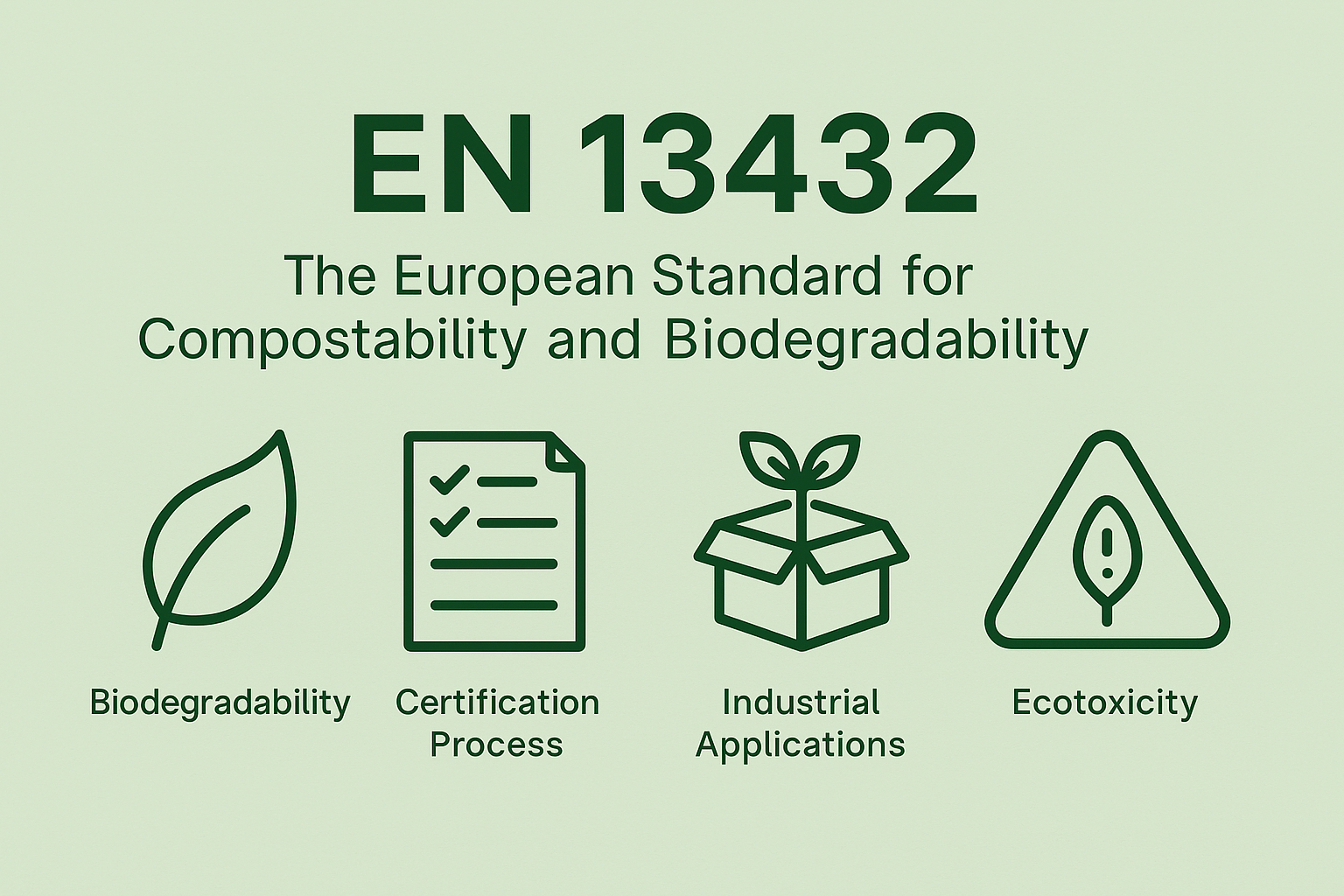
In today's world, the increasing plastic pollution is driving a growing demand for sustainable alternatives in packaging and waste management. One of the key standards in this field is EN 13432 – the European standard that defines the criteria for compostability and biodegradability of packaging materials. It ensures that certified products can break down under industrial composting conditions without leaving toxic residues in the environment.
What is EN 13432?
EN 13432 is a standard developed by the European Committee for Standardization (CEN) and officially adopted in 2000. It sets the requirements that a material must meet to be classified as compostable in an industrial environment. Compostability means that the material can completely decompose under the influence of microbes, high temperature, and humidity within a specific period, without leaving harmful traces in the soil.
Key Requirements of EN 13432
To be certified under EN 13432, a material must pass a series of strict tests assessing its biodegradability, disintegration, chemical composition, and environmental impact. The main criteria include:
- Biodegradability – The material must degrade by at least 90% within six months under microbial activity in an industrial composting system. The degradation process is measured by the amount of carbon dioxide (CO₂) released.
- Disintegration – After 12 weeks, at least 90% of the material's mass must break down into particles small enough to pass through a 2mm sieve. This ensures that the product does not leave large residues in the final compost.
- Absence of Toxic Residues – Once the material decomposes, the resulting compost must be safe for the environment and free from harmful residues that could hinder plant growth.
- Limited Heavy Metal Content – The material must not contain hazardous amounts of heavy metals such as cadmium, lead, mercury, chromium, and others that could pollute the soil and groundwater.
- Ecotoxicity – The final compost must be tested on plants to ensure it does not negatively impact their growth and development. This is crucial for preventing contamination of agricultural soils.
Certification Process
Companies seeking EN 13432 certification for their products must undergo a detailed procedure, including laboratory tests and independent evaluation by accredited bodies. The most well-known certification institutions in Europe include TÜV Austria (OK Compost and OK Compost HOME certifications) and DIN CERTCO (Seedling Logo). Upon successful testing, the product is awarded the respective certificate and can be marked with a special label indicating compliance with the standard.
Applications of EN 13432 in Industry
Products certified under EN 13432 are widely used across various industries, including food packaging, retail, and waste management. Some common examples include:
- Compostable shopping bags and biodegradable waste bags for organic waste.
- Food packaging made from plant-based materials such as polylactic acid (PLA) or starch.
- Disposable cups, plates, and cutlery that can be disposed of in composting systems.
- Compostable coffee capsules that reduce the environmental footprint of single-use plastic capsules.
Limitations of EN 13432
While certification under EN 13432 is a crucial step toward sustainable waste management, several important limitations should be considered:
- Not all products are home-compostable – EN 13432 primarily applies to industrial composting conditions, where temperatures are significantly higher. Products that can compost in home environments must carry the OK Compost HOME certification.
- Compostable materials do not degrade quickly in nature – If discarded in the environment, these materials may decompose slower than expected since natural conditions differ from those in industrial composting facilities.
- Not all composting facilities accept these materials – In some countries or regions, composting centers are not yet equipped to process compostable packaging, which may limit eco-friendly disposal options.
The Importance of EN 13432 for Sustainable Development
EN 13432 certification plays a key role in sustainability efforts by providing standardized criteria for the compostability and biodegradability of packaging materials. This not only reduces the negative impact on the environment but also supports the transition to a circular economy, where resources are used more efficiently and waste is minimized. Companies that adopt this standard demonstrate their commitment to environmental protection and sustainable resource use while enhancing their reputation among consumers and partners.
Implementation of management standards
CONSEJO Ltd. is a consulting company with over 20 years of practical experience in the development, implementation and maintenance of management systems in accordance with international standards and regulatory requirements. The company provides consulting services in the areas of quality management, environmental management, occupational health and safety, food safety, information security, cybersecurity, risk management and sustainable development. Our expertise covers standards and schemes such as ISO 9001, ISO 14001, ISO 45001, ISO 22000, ISO/IEC 27001, IFS Food, BRCGS and HACCP, as well as consulting services related to NIS2, DORA, GDPR and EcoVadis.
The CONSEJO team has been involved in over 1,500 projects for organizations across various sectors of the economy, including manufacturing, construction, energy, information technology, transport, trade, the food industry and services. Our approach focuses on developing management systems that work effectively in practice, tailored to the specific characteristics and needs of each organization. We work closely with our clients, providing consulting support, staff training and assistance during implementation. We strive to deliver high-quality services within the agreed deadlines and solutions that support successful certification and create long-term value for businesses.


