
Directive (EU) 2024/1760 (CSDDD/CS3D) – Sustainability Due Diligence and the New Obligations for Companies
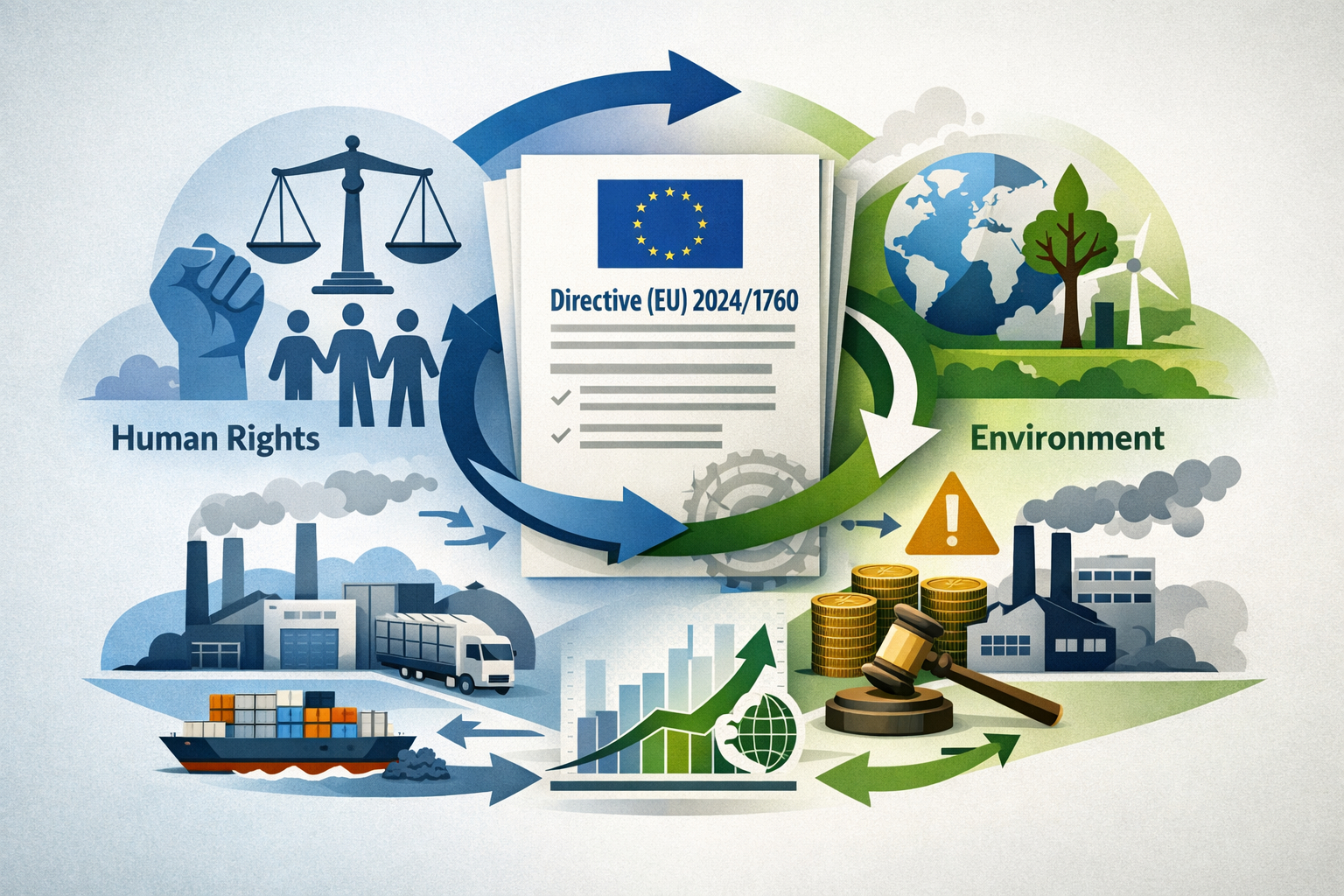 On 13 June 2024, the European Parliament and the Council adopted Directive (EU) 2024/1760 on corporate sustainability due diligence (Corporate Sustainability Due Diligence Directive – CSDDD/CS3D). The Directive enters into force on 25 July 2024.
The Directive establishes an EU-wide framework requiring large companies (and certain non-EU companies) to implement a risk-based due diligence process covering:
• human rights; and
• the environment,
within their own operations, the activities of their subsidiaries, and certain business partners across the company’s chain of activities.
What Does the Directive Regulate?
The Directive lays down rules concerning:
- obligations to prevent, mitigate and bring to an end adverse impacts on human rights and the environment;
- civil liability for specific breaches;
- an obligation to adopt and implement a climate change mitigation transition plan.
Which Companies Fall Within the Scope?
1) Companies Established in the EU
The Directive applies to companies established under the law of a Member State that meet at least one of the following criteria:
• more than 1,000 employees (on average) and net worldwide turnover exceeding EUR 450 million in the last financial year; or
• they are the ultimate parent undertaking of a group that meets these thresholds; or
• they operate under a franchise or licensing model with royalties exceeding EUR 22.5 million and net turnover exceeding EUR 80 million (subject to the conditions set out in the Directive).
2) Companies from Third Countries (Outside the EU) Operating on the EU Market
The Directive also applies to companies established under the law of a third country if they:
• generate net turnover in the EU exceeding EUR 450 million; or
• are the parent undertaking of a group with such turnover in the EU; or
• have franchise or licensing agreements in the EU (royalties exceeding EUR 22.5 million and net turnover in the EU exceeding EUR 80 million).
What Does “Due Diligence” Mean under the CSDDD?
The Directive requires a systematic process that is not a one-off assessment, but a continuous cycle of actions integrated into corporate governance.
At a high level, due diligence under the Directive includes the following steps:
• integration into corporate policies and risk management systems;
• identification and assessment of actual and potential adverse impacts;
• prioritisation where not all impacts can be addressed at once;
• preventive measures (for potential impacts) and measures to bring to an end or minimise impacts (for actual impacts);
• remediation, where applicable;
• a complaints and notification mechanism and engagement with stakeholders;
• monitoring of effectiveness;
• public communication.
Climate Transition Plan – A Key New Requirement
Companies within scope must adopt and implement a climate change mitigation transition plan aimed at ensuring that their business model and strategy are compatible with the transition to a sustainable economy and with limiting global warming to 1.5°C, in line with the Paris Agreement.
The plan includes, among its key elements:
• time-bound decarbonisation targets;
• key actions and levers (including changes to products/services and technologies);
• investments and financing;
• the role of management and supervisory bodies;
• annual updates and progress reporting.
Important: where a company already prepares a transition plan under the Corporate Sustainability Reporting Directive (CSRD), it may be deemed to have fulfilled this requirement, subject to the conditions set out in the Directive.
Link with Whistleblowing and the European Single Access Point
The Directive amends Directive (EU) 2019/1937 (on the protection of persons who report breaches of Union law), extending protection to reports concerning breaches of national measures transposing the CSDDD.
In addition, the Directive amends Regulation (EU) 2023/2859 on the European Single Access Point (ESAP), with the objective of making information and public disclosures related to due diligence more accessible and better structured at EU level.
Transposition Deadlines and Phased Application
Member States must adopt national measures transposing the Directive by 26 July 2026.
The application of the Directive will be phased in, with different thresholds and timelines. The first obligations will apply from 26 July 2027 for the largest companies, with later application dates for other companies, in accordance with the schedule set out in the Directive.
What Does This Mean for Business in Practice?
Although the Directive targets large companies, its effects are expected to cascade throughout value chains and contractual relationships.
Expected consequences include:
• stricter contractual requirements for suppliers (codes of conduct, assurances, audits);
• higher expectations for traceability and risk management;
• closer integration between ESG reporting, risk management, compliance and internal controls;
• the need for realistic climate transition plans with demonstrable progress.
Implementation of management standards
CONSEJO Ltd. is a consulting company with over 20 years of practical experience in the development, implementation and maintenance of management systems in accordance with international standards and regulatory requirements. The company provides consulting services in the areas of quality management, environmental management, occupational health and safety, food safety, information security, cybersecurity, risk management and sustainable development. Our expertise covers standards and schemes such as ISO 9001, ISO 14001, ISO 45001, ISO 22000, ISO/IEC 27001, IFS Food, BRCGS and HACCP, as well as consulting services related to NIS2, DORA, GDPR and EcoVadis.
The CONSEJO team has been involved in over 1,500 projects for organizations across various sectors of the economy, including manufacturing, construction, energy, information technology, transport, trade, the food industry and services. Our approach focuses on developing management systems that work effectively in practice, tailored to the specific characteristics and needs of each organization. We work closely with our clients, providing consulting support, staff training and assistance during implementation. We strive to deliver high-quality services within the agreed deadlines and solutions that support successful certification and create long-term value for businesses.


