
ISO 9001:2026 Published – What Is Changing and How Organizations Can Prepare for the Transition
 On 16 September 2026, the International Organization for Standardization (ISO) officially published ISO 9001:2026 – Quality management systems — Requirements, the sixth edition of the world’s most widely used international standard for quality management systems.
The new edition replaces ISO 9001:2015 and incorporates the changes introduced by ISO 9001:2015/Amd 1:2024.
ISO presents the revision as an evolution of the existing standard rather than a fundamental change to its underlying framework. The core structure and established quality management principles have been retained, while the changes are aimed at greater clarity of the requirements, improved usability and adaptation to the contemporary organizational environment.
What are the main changes in ISO 9001:2026?
ISO highlights several key areas of change in the new edition.
1. Core terms and definitions are included in Clause 3
Clause 3 now includes a limited set of core terms and definitions used in ISO management system standards.
ISO 9000 remains the normative reference for quality management terms and definitions.
This change supports greater clarity and better alignment with other ISO management system standards.
2. Quality culture and ethical behaviour
One of the significant changes is the introduction of quality culture and ethical behaviour into the requirements of the standard.
These topics are now addressed particularly in relation to:
- leadership;
- awareness;
- the environment for the operation of processes.
3. Clearer distinction between risks and opportunities
ISO 9001:2026 makes a clearer distinction between risks and opportunities, including with regard to the actions an organization takes to address each.
This distinction is further developed in the Introduction to the standard, where opportunity-based thinking is now explicitly referred to alongside risk-based thinking.
Risk-based thinking is aimed at preventing undesired results, while opportunity-based thinking is aimed at pursuing desired results by taking advantage of opportunities.
For organizations, this means reviewing not only how they determine and address risks, but also how they identify and take advantage of opportunities to achieve desired results.
4. Strengthened management of change
Requirements related to changes to the quality management system have been strengthened to support the achievement of intended results.
Management of change should therefore be one of the areas organizations review when assessing how their existing quality management system aligns with ISO 9001:2026.
Organizations should assess the extent to which their processes ensure the planned and controlled management of changes that may affect the quality management system and the achievement of intended results.
5. Internal Audits
The new edition also places greater emphasis on defining the criteria, objectives and scope of internal audits. This is an area that organizations should review when preparing their quality management systems for the application of ISO 9001:2026.
6. Enhanced Annex A
The informative Annex A has been revised and enhanced.
Its purpose is to provide additional clarification of the structure, terminology and intent of the requirements of ISO 9001:2026.
Importantly, Annex A is informative and does not introduce any additional requirements.
This makes it particularly useful for interpreting and applying the new edition of the standard in practice.
7. Annex B has been removed
Annex B of ISO 9001:2015, which provided information on other ISO/TC 176 standards, has been removed.
References to these standards are now included in Annex A and on the ISO/TC 176 website.
What is retained in ISO 9001:2026?
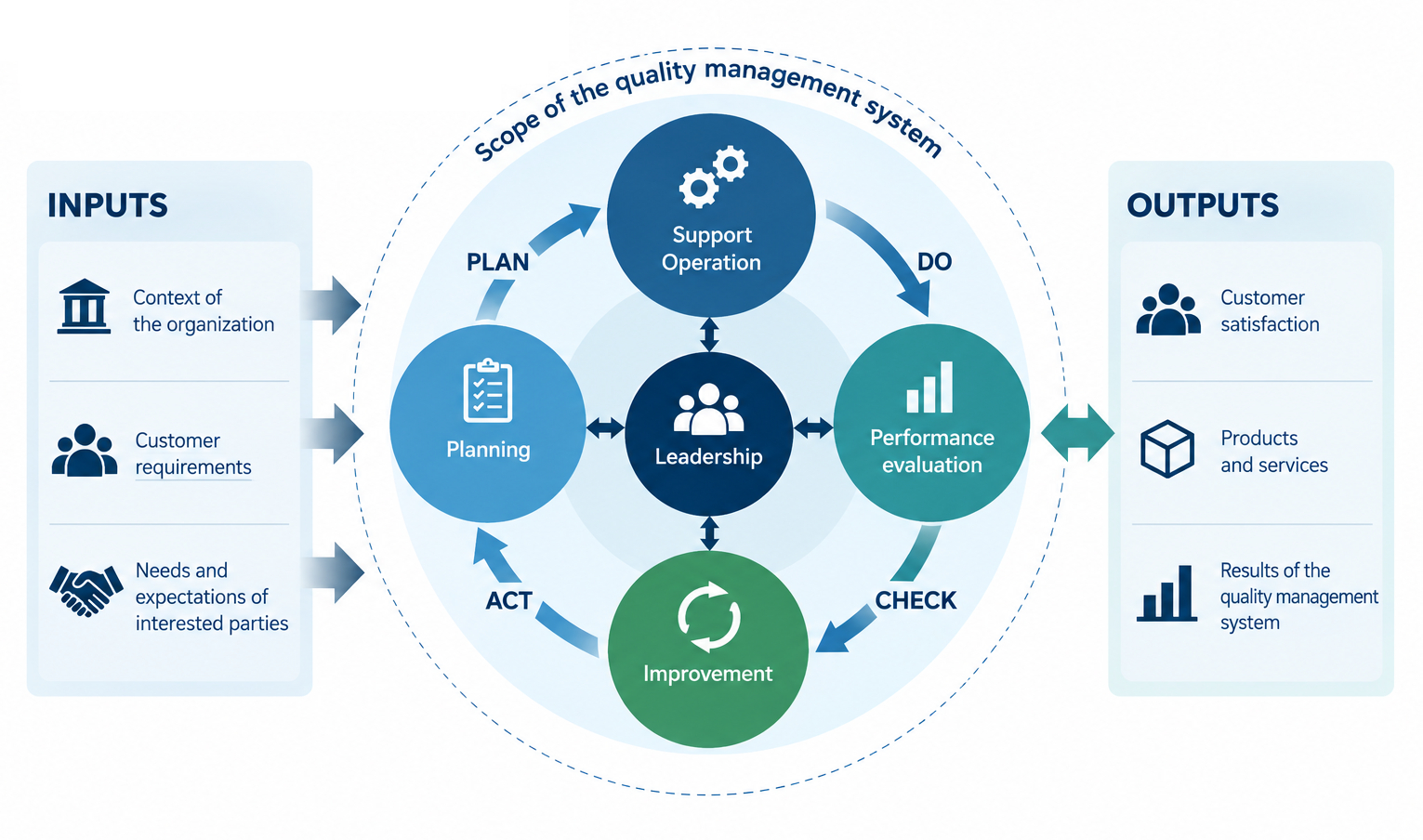
Despite the revision, ISO 9001:2026 retains the fundamental principles and approaches on which the quality management system is based.
The standard continues to be based on the seven quality management principles:
- customer focus;
- leadership;
- engagement of people;
- process approach;
- improvement;
- evidence-based decision-making;
- relationship management.
The new edition applies ISO’s harmonized approach for management system standards, supporting the alignment and integration of ISO 9001 requirements with other management system standards.
What does the new edition mean for organizations certified to ISO 9001:2015?
The publication of ISO 9001:2026 gives organizations an opportunity to review and update their quality management systems in line with the new requirements and the expectations of relevant interested parties.
Organizations certified to ISO 9001:2015 will need to transition to the new edition within the timeframe set by their certification cycle.
For specific information regarding the planning and implementation of the transition, organizations should contact their certification body.
How can organizations start preparing?
Regardless of the specific timetable for the certification transition, organizations can start preparing now.
A practical approach may include:
- becoming familiar with the final requirements of ISO 9001:2026;
- conducting a GAP analysis between the existing system and the new edition;
- assessing how the organization addresses risks and opportunities;
- reviewing mechanisms for managing change;
- assessing how quality culture and ethical behaviour are integrated into management and operational processes;
- identifying and implementing the necessary changes to the existing management system, including changes to processes, responsibilities and documented information;
- training and raising awareness among management and employees;
- planning and implementing the necessary actions in accordance with the transition timetable agreed with the certification body.
Next steps
The publication of ISO 9001:2026 marks the beginning of a new stage for organizations applying the standard.
Although the revision retains the core structure and principles of ISO 9001, the new edition introduces changes that require a systematic review of existing quality management systems.
An early GAP analysis can help an organization identify the necessary actions, establish priorities and plan the transition to ISO 9001:2026 in a structured manner.
Implementation of management standards
CONSEJO Ltd. is a consulting company with over 20 years of practical experience in the development, implementation and maintenance of management systems in accordance with international standards and regulatory requirements. The company provides consulting services in the areas of quality management, environmental management, occupational health and safety, food safety, information security, cybersecurity, risk management and sustainable development. Our expertise covers standards and schemes such as ISO 9001, ISO 14001, ISO 45001, ISO 22000, ISO/IEC 27001, IFS Food, BRCGS and HACCP, as well as consulting services related to NIS2, DORA, GDPR and EcoVadis.
The CONSEJO team has been involved in over 1,500 projects for organizations across various sectors of the economy, including manufacturing, construction, energy, information technology, transport, trade, the food industry and services. Our approach focuses on developing management systems that work effectively in practice, tailored to the specific characteristics and needs of each organization. We work closely with our clients, providing consulting support, staff training and assistance during implementation. We strive to deliver high-quality services within the agreed deadlines and solutions that support successful certification and create long-term value for businesses.


