
ISO 22002-1:2025 and ISO 22002-100:2025 – Important Changes in Food Safety Prerequisite Programmes
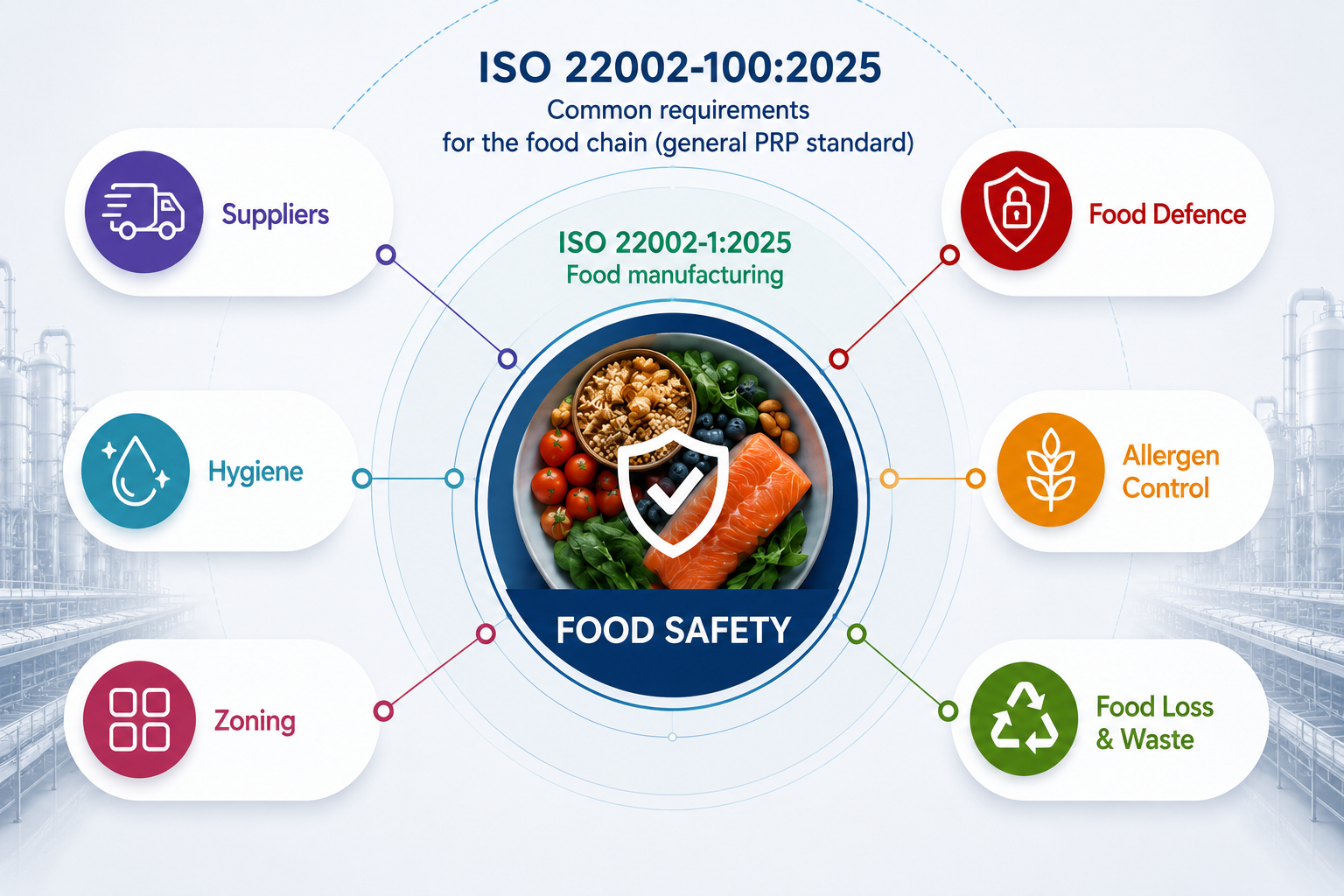 In 2025, the International Organization for Standardization (ISO) published some of the most significant changes to the ISO 22002 series since its creation. The new standards ISO 22002-1:2025 and ISO 22002-100:2025 are changing the way organizations establish and manage prerequisite programmes (PRPs) for food safety by introducing a new structure of requirements, centralization of common requirements, and a clearer risk-based approach.
These changes are linked to the development of ISO 22000:2018, the requirements of FSSC 22000 v6, and the growing importance of topics such as allergen management, food defence, food fraud prevention, sustainability, and the reduction of food loss and waste.
What is the ISO 22002 series?
The ISO 22002 series contains the requirements for prerequisite programmes that support the control of food safety hazards within food safety management systems based on ISO 22000. These programmes cover the basic hygienic, technical, and organizational conditions necessary for the safe manufacture, storage, transport, and handling of food products.
In previous versions, each sector-specific part of ISO 22002 included both common and sector-specific requirements. This often resulted in duplicated requirements and implementation difficulties for organizations operating in more than one sector of the food chain.
The new structure of the series aims to eliminate these duplications and provide a more consistent approach.
ISO 22002-100:2025 – the new common standard for prerequisite programmes
The most significant change is the separation of requirements into two levels. The common hygiene and operational requirements applicable across all sectors of the food chain are now consolidated in ISO 22002-100:2025 Prerequisite programmes on food safety — Part 100: Requirements for the food, feed and packaging supply chain. Sector-specific requirements remain within the individual parts of the ISO 22002 series.
The approach is intended to simplify implementation: instead of repeating the same common requirements in each sector-specific document, these requirements are described in a single standard, while the sector-specific parts contain only those additional requirements relevant to the particular activity. For organizations operating simultaneously in several areas – for example food manufacturing, storage, and packaging – this significantly simplifies implementation, maintenance, and verification activities.
Sector-specific application of the ISO 22002 series
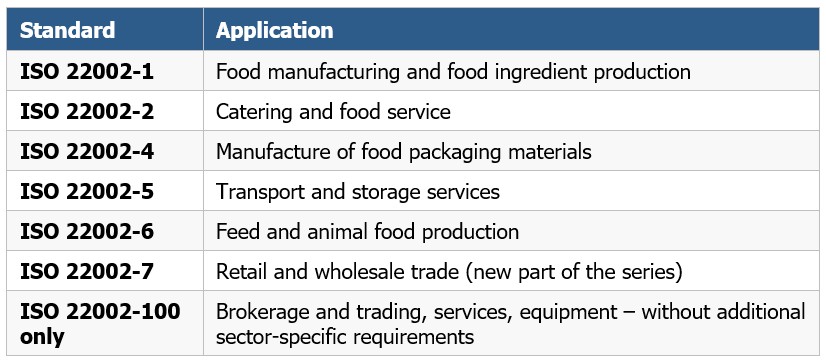
With the publication of the new series, ISO 22002-7:2025 for retail and wholesale trade was also introduced. As a result, this sector now has its own dedicated part within the ISO 22002 series, applied together with ISO 22002-100. ISO 22002-7 builds upon and replaces the previous approach used in PAS 221 by formally incorporating retail and wholesale activities into the structure of the ISO 22002 series.
Key changes for food manufacturers
The new version of ISO 22002-1:2025 is significantly shorter than its predecessor – approximately nine pages of core content. The reason is that the common requirements are now contained in ISO 22002-100. ISO 22002-1 Prerequisite programmes on food safety — Part 1: Food manufacturing now includes only those requirements that are specific to food manufacturing operations.
Many clauses in the new standard directly refer to ISO 22002-100 with the statement: "The requirements in ISO 22002-100 shall apply." This means that food manufacturers are expected to implement ISO 22002-1:2025 together with ISO 22002-100:2025, since the common PRP requirements are contained in ISO 22002-100, while ISO 22002-1 includes the additional sector-specific requirements for food manufacturing.
Food manufacturing-specific requirements
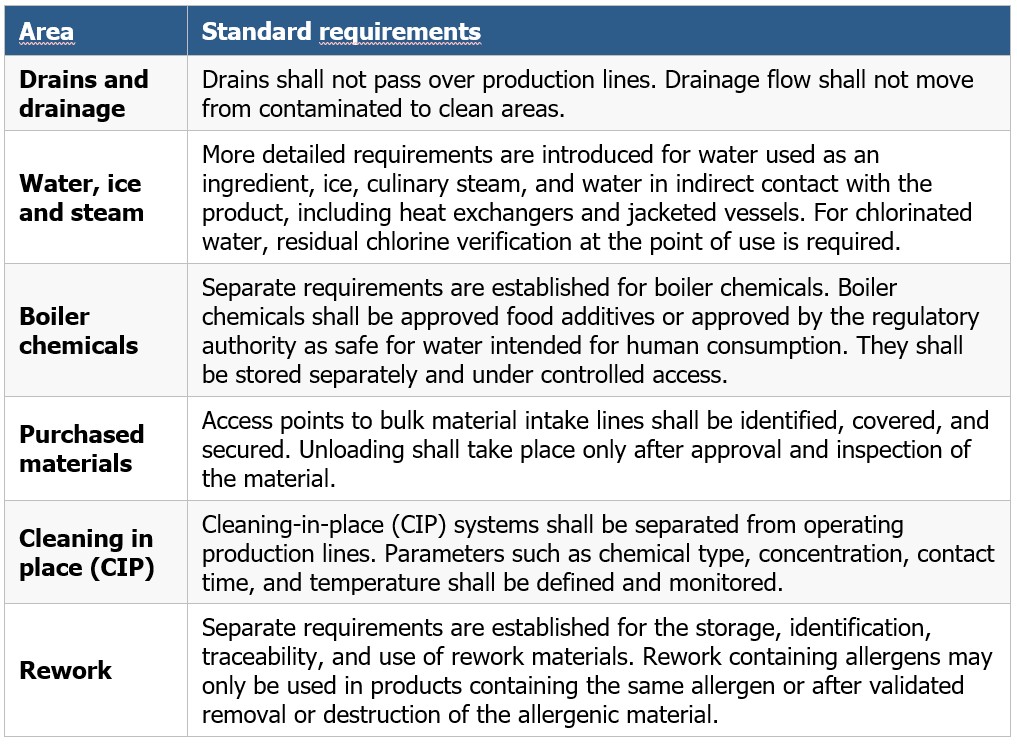
Stronger focus on allergen management
One of the most significant changes in ISO 22002-1:2025 is the expanded approach to allergen management.
The new standard introduces more detailed requirements regarding:
- prevention of unintended allergen cross-contact;
- management of rework materials;
- airflow control;
- use of dedicated equipment and utensils;
- production sequencing;
- personnel training.
Clearer requirements for contamination prevention
The new standards introduce a more structured approach to the control of physical, chemical, and microbiological contamination.
ISO 22002-1:2025 places greater emphasis on:
- zoning;
- separation of raw and finished products;
- airflow management;
- control of personnel and material movement;
- use of dedicated tools and equipment.
More detailed requirements for cleaning-in-place systems
The new version introduces a separate section for cleaning-in-place (CIP) systems.
The standard requires organizations to define and control:
- chemical concentration;
- temperature;
- contact time;
- monitoring and verification methods.
Management of food loss and waste
ISO 22002-100:2025 also introduces a new element related to food loss and waste (FLW) management.
This is linked to global developments in sustainability, environmental and social responsibility, and circular economy principles.
Organizations are now expected not only to manage waste, but also to control:
- food loss;
- storage conditions;
- traceability;
- disposal;
- safe recycling and reuse of materials.
Food defence and food fraud prevention
One of the most relevant topics in the new standards is the management of intentional threats to food safety.
ISO 22002-100:2025 places particular emphasis on:
- food defence;
- food fraud prevention.
- assessment of potential threats related to intentional acts against food;
- assessment of vulnerabilities within the supply chain;
- determination of appropriate mitigation measures;
- periodic review and updating of these measures.
- CCTV systems;
- access control;
- vehicle tracking;
- protection of information systems;
- tamper prevention measures for products and packaging;
- supplier reliability assessment.
Risk-based approach
The new standards continue and further develop the risk-based approach established in ISO 22000:2018.
The text repeatedly uses expressions such as: "where applicable"; "where necessary"; "based on risk"; "documented information". This means that organizations are expected not merely to demonstrate formal compliance with requirements, but also to demonstrate that the implemented measures are appropriate to the actual food safety risks.
The approach provides greater flexibility, but also places greater responsibility on organizations to:
- conduct justified risk assessments;
- justify decisions taken;
- document implemented measures;
- demonstrate their effectiveness.
Better alignment with the updated Codex HACCP principles
One of the objectives of the changes is improved alignment with the updated HACCP principles of Codex Alimentarius and modern food safety management principles.
The new series reflects developments in international practice, the evolution of global supply chains, and the need for improved traceability and supplier management.
Greater consistency across sectors
One of the main objectives of ISO 22002-100 is to ensure more consistent implementation of prerequisite programmes across all sectors of the food chain.
This is particularly important for organizations operating simultaneously in several areas – for example manufacturing, storage, packaging, and retail or wholesale activities. The new structure reduces duplication of documentation, training, and verification activities.
What do the changes mean for businesses?
At present, FSSC 22000 version 6 still uses the previous ISO/TS 22002 standards. The new standards are expected to be incorporated into FSSC 22000 version 7 together with a defined transition period.
For organizations, this means that it is advisable to begin analysing the differences between the old and new requirements in order to prepare for a smooth transition to future certification requirements.
The publication of ISO 22002-1:2025 and ISO 22002-100:2025 will require the review and updating of existing food safety prerequisite programmes.
Organizations are expected to:
- conduct a gap analysis against their existing prerequisite programmes and identify deficiencies;
- develop and implement a documented food defence plan against intentional threats, where such a plan does not already exist;
- develop and implement a food fraud prevention plan together with a vulnerability assessment;
- expand waste management programmes to include food loss;
- update supplier management procedures, including the definition of appropriate evidence of conformity such as certificates of analysis and declarations of conformity, where applicable;
- provide training to personnel on all new requirements.
- allergen management;
- prevention of intentional contamination;
- assessment of supply chain vulnerabilities.
How we can help?
The CONSEJO team monitors all developments related to the new international standards and offers a full range of consulting services to support enterprises across the food chain:
- gap analysis against the new requirements of ISO 22002-1:2025 and ISO 22002-100:2025;
- development and adaptation of documented procedures, instructions, assessments, and plans;
- preparation of threat and vulnerability assessments related to food defence and food fraud prevention requirements;
- training for management and operational personnel;
- preparation for external audits under FSSC 22000 and similar schemes;
- ongoing consulting support during the transition period.
ISO 22002-1:2025 and ISO 22002-100:2025 represent an important step in the development of food safety prerequisite programmes.
The new structure centralizes common requirements, reduces duplication between sectors, and facilitates organizations operating in more than one area of the food chain.
The standards demonstrate the evolution of the food safety approach – from traditional hygiene control towards more integrated management of risk, security, sustainability, and supply chain protection.
Implementation of management standards
CONSEJO Ltd. is a consulting company with over 20 years of practical experience in the development, implementation and maintenance of management systems in accordance with international standards and regulatory requirements. The company provides consulting services in the areas of quality management, environmental management, occupational health and safety, food safety, information security, cybersecurity, risk management and sustainable development. Our expertise covers standards and schemes such as ISO 9001, ISO 14001, ISO 45001, ISO 22000, ISO/IEC 27001, IFS Food, BRCGS and HACCP, as well as consulting services related to NIS2, DORA, GDPR and EcoVadis.
The CONSEJO team has been involved in over 1,500 projects for organizations across various sectors of the economy, including manufacturing, construction, energy, information technology, transport, trade, the food industry and services. Our approach focuses on developing management systems that work effectively in practice, tailored to the specific characteristics and needs of each organization. We work closely with our clients, providing consulting support, staff training and assistance during implementation. We strive to deliver high-quality services within the agreed deadlines and solutions that support successful certification and create long-term value for businesses.


