
ISO 14001:2026 – Key Changes and Practical Transition Steps
 In April 2026, the International Organization for Standardization published the new edition of ISO 14001 – the most widely used international standard for environmental management systems. At the end of June, the Bulgarian Institute for Standardization published the official Bulgarian-language edition of the standard.
Hundreds of thousands of organizations worldwide certified to ISO 14001:2015 are now facing the question: what is changing, and how should they prepare for the transition to the new edition?
This article presents an analysis of the key changes – both from a strategic perspective for managers and with specific technical details for environmental management system specialists.
Why Was a New Edition Needed?
The 2015 edition of the standard was a significant step forward: it introduced stronger risk-based thinking, a life cycle perspective, and better integration of the environmental management system into the organization’s business processes.
Ten years later, however, the context is different. Climate change is no longer seen only as a future risk, but as a reality with measurable financial, social and business consequences. Biodiversity loss, ecosystem degradation, depletion of natural resources and increasing regulatory requirements have become issues closely monitored by investors, customers, regulators and society.
ISO 14001:2026 does not overturn the existing environmental management system (EMS) model; rather, it deepens it. The new edition makes the system more specific, more closely linked to real environmental challenges, and more aligned with the organization’s strategic direction.
Strategic Changes: What Managers Need to Know
Climate, biodiversity and ecosystems are placed more clearly at the centre of analysis
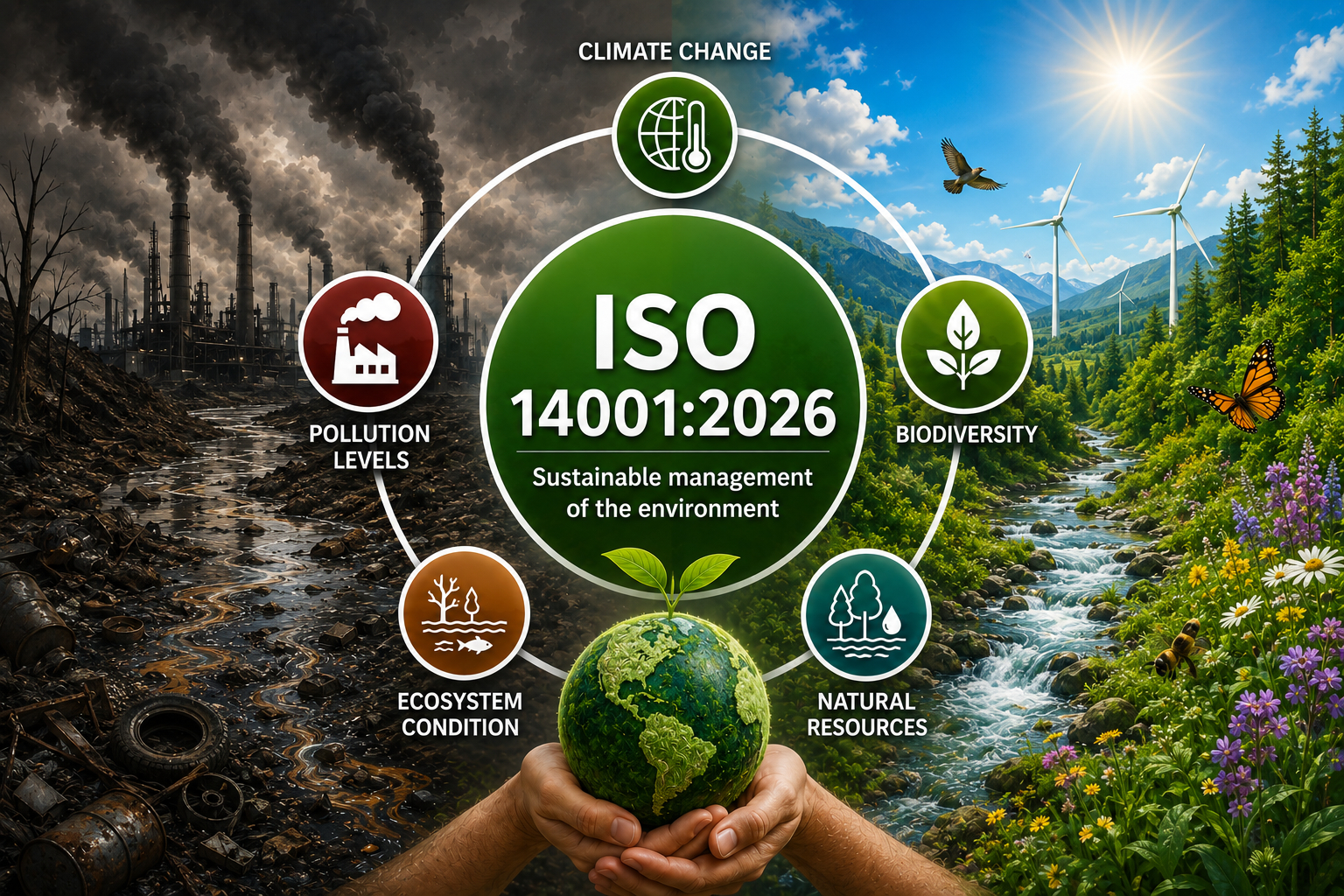
The most visible change in ISO 14001:2026 is the clearer inclusion of topics such as climate change, biodiversity, natural resources, pollution levels and ecosystem health.
In Clause 4.1, which concerns the context of the organization, specific examples are now provided of environmental conditions that the organization must consider. These include the availability of natural resources, climate change, biodiversity and ecosystem health.
Clause 4.2 also clarifies that interested parties may have needs and expectations related to these conditions. This means that the organization should assess not only its impacts on the environment, but also how environmental conditions can affect its activities.
In practice, this is important for any organization that depends on water resources, uses land, generates significant emissions, works with natural raw materials or operates near sensitive or protected areas. During audits, evidence will be expected that these issues have been considered in the organization’s context, environmental aspects, risks and opportunities.
The scope of the EMS must be available to interested parties
Under ISO 14001:2015, the scope of the environmental management system had to be maintained as documented information and be available. In ISO 14001:2026, the wording is more specific: the scope shall be available as documented information and shall be available to interested parties.
This is not merely an editorial change. It reflects the broader trend towards transparency on environmental matters. The organization must be able to clearly show which activities, products, services, sites and processes are included in its environmental management system.
The link between the EMS and business strategy remains key
The requirement for the environmental policy and environmental objectives to be compatible with the strategic direction and context of the organization is not entirely new – it already existed in ISO 14001:2015. In the new edition, however, this link is retained and strengthened through clearer structuring of risks and opportunities, planning action, planning of changes, and management review.
Organizations where the EMS operates formally and is disconnected from real business decisions will face increasing challenges. The new edition encourages environmental management to become part of strategic management, not merely a means of maintaining a certificate.
New and Revised Requirements: What EMS Specialists Need to Know
New Clause 6.1.4 – Risks and opportunities
In ISO 14001:2015, risks and opportunities were mainly addressed under Clause 6.1.1. In ISO 14001:2026, they are set out in a separate Clause 6.1.4.
The organization is required to determine the risks and opportunities related to:
- environmental aspects;
- compliance obligations;
- external and internal issues;
- needs and expectations of interested parties;
- the scope of the environmental management system.
The risks and opportunities that need to be addressed shall be available as documented information.
 New Clause 6.1.5 – Planning action
ISO 14001:2026 also introduces a separate Clause 6.1.5 dedicated to planning action. The organization must plan actions to address:
- significant environmental aspects;
- compliance obligations;
- risks and opportunities.
This moves organizations away from a “list of measures” approach towards more integrated planning, where actions logically result from the analysis of context, aspects, obligations, risks and opportunities.
New Clause 6.3 – Planning of changes
One of the most important changes is the introduction of Clause 6.3, “Planning of changes”.
When the organization determines the need for changes that affect or can affect the environmental management system, those changes must be carried out in a planned manner. The changes must be managed so that the organization can continue to achieve the intended outcomes of its EMS.
This requirement is particularly important in cases such as:
- introduction of new products or services;
- changes to production processes;
- changes to equipment, technologies or raw materials;
- changes to organizational structure;
- new or changed legal requirements;
- emergency or unplanned changes.
Communication – stronger emphasis on evidence
Clause 7.4.1 has also been revised. In ISO 14001:2026, appropriate documented information shall be available as evidence of the organization’s communications.
This means that the organization must be able to show what EMS-related information has been communicated, to whom, when and how. This is particularly important for communication related to legal requirements, environmental performance, significant environmental aspects, emergency situations, complaints and expectations of interested parties.
The new edition also places a clear emphasis on the reliability of communicated environmental information. Such information must be consistent with the information generated within the environmental management system and must be reliable.
Management review – clearer structure and strategic focus
Clause 9.3 has been restructured into three subclauses:
9.3.1 General;
9.3.2 Management review inputs;
9.3.3 Management review results.
The content largely follows the logic of ISO 14001:2015, but is presented more clearly. An important emphasis is that the results of management review must also include any implications for the strategic direction of the organization.
This confirms that management review should not be a formal annual meeting, but a real management tool. It should support decisions on resources, changes, improvements, priorities and the relationship between the EMS and business strategy.
Terminological Changes: Important, but Not Automatically a Nonconformity
ISO 14001:2026 introduces a number of terminological changes. They are important for clarity, consistency and better understanding of the requirements, but one point should be emphasized: the standard does not require the organization to use the same structure or the same terminology in its own documentation.
The organization may use terms that suit its business, provided that the meaning is clear and the requirements of the standard are fulfilled. Therefore, different terminology in itself is not automatically a nonconformity.
Nevertheless, when updating documentation, it is advisable to review key concepts such as:
- “effectiveness”;
- “performance”;
- “environmental performance”;
- “indicator”;
- “monitoring”;
- “continual improvement”;
- “risks and opportunities”, instead of treating “risk” as a standalone concept.
Annex A: Informative, but Useful for Implementation
Annex A remains informative – it does not add new requirements and does not change the requirements of the standard. Nevertheless, it is extremely useful for their correct understanding and application.
In ISO 14001:2026, Annex A has been expanded and provides more guidance on:
- analysis of context;
- environmental conditions;
- climate change;
- biodiversity;
- ecosystem health;
- risks and opportunities;
- managing change;
- management review.
 What Has Not Changed
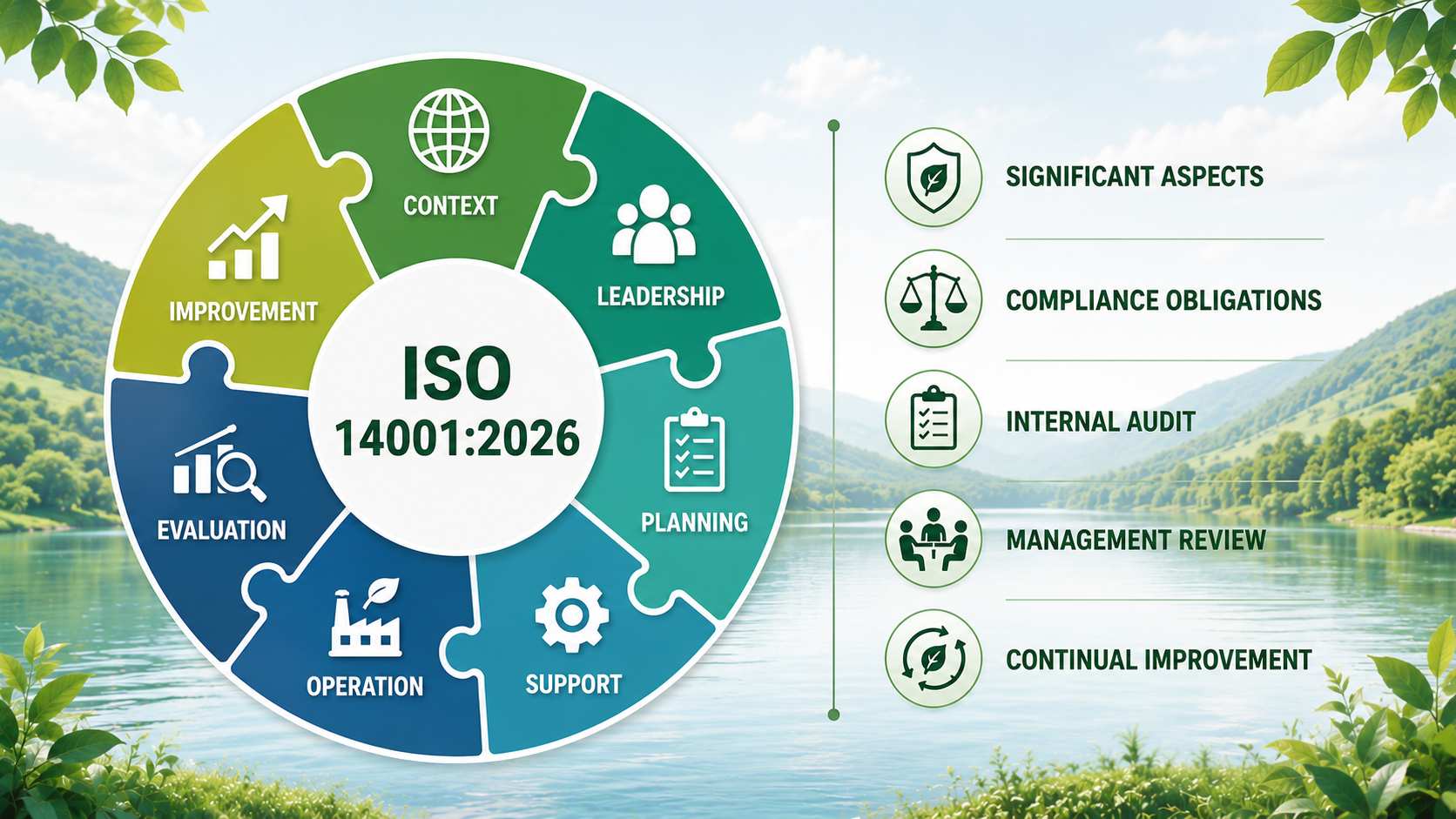
It is important to emphasize that ISO 14001:2026 does not require the system to be rebuilt from scratch. The core architecture of the standard remains familiar: context, leadership, planning, support, operation, performance evaluation and improvement.
The main principles remain in place:
- risk-based approach;
- life cycle perspective;
- management of significant environmental aspects;
- meeting compliance obligations;
- internal audit;
- management review;
- continual improvement.
Transition Timelines and Practical Steps
In practice, the transition to ISO 14001:2026 is expected to take place within approximately three years from the publication of the new edition, with the specific timelines and rules determined by accreditation and certification bodies.
Organizations should not wait until the last moment. Good preparation includes several consecutive steps.
First, a gap analysis is needed – a systematic review of the existing system against the new and revised requirements of ISO 14001:2026.
The changes should then be prioritized. The most important areas are the new and restructured requirements related to risks and opportunities, planning action, planning of changes, communication and management review.
Special attention should be paid to planning of changes under Clause 6.3. Organizations with frequent changes in processes, products, equipment, external providers or regulatory requirements will need to integrate the EMS more deeply into operational management.
The next step is to update documentation, train responsible personnel and conduct an internal audit against ISO 14001:2026 before the transition certification or surveillance audit.
ISO 14001:2026 raises the bar for organizations, as expectations regarding environmental management are also increasing. Regulators, customers, investors and other interested parties increasingly expect not only a certificate, but also evidence of effective management of environmental risks, improved environmental performance and transparency.
The new edition should not be seen merely as a documentation update project. It is an opportunity for the organization to assess how effectively it manages its environmental impacts, its dependencies on natural resources, its compliance obligations, and the risks associated with the changing environmental and business context.
Organizations that approach ISO 14001:2026 in a timely and structured way will be better prepared for the transition and will be able to derive real value from their environmental management system — through better resource management, lower regulatory risks, a stronger position with customers and partners, and greater resilience to future requirements.
Consejo provides gap analysis, documentation development and updating, training, and preparation for certification audits against ISO 14001:2026. Contact us to discuss your organization’s transition to the new edition.
Implementation of management standards
CONSEJO Ltd. is a consulting company with over 20 years of practical experience in the development, implementation and maintenance of management systems in accordance with international standards and regulatory requirements. The company provides consulting services in the areas of quality management, environmental management, occupational health and safety, food safety, information security, cybersecurity, risk management and sustainable development. Our expertise covers standards and schemes such as ISO 9001, ISO 14001, ISO 45001, ISO 22000, ISO/IEC 27001, IFS Food, BRCGS and HACCP, as well as consulting services related to NIS2, DORA, GDPR and EcoVadis.
The CONSEJO team has been involved in over 1,500 projects for organizations across various sectors of the economy, including manufacturing, construction, energy, information technology, transport, trade, the food industry and services. Our approach focuses on developing management systems that work effectively in practice, tailored to the specific characteristics and needs of each organization. We work closely with our clients, providing consulting support, staff training and assistance during implementation. We strive to deliver high-quality services within the agreed deadlines and solutions that support successful certification and create long-term value for businesses.


