
ISO 13009:2015 – An International Standard for Beach Operation and Management
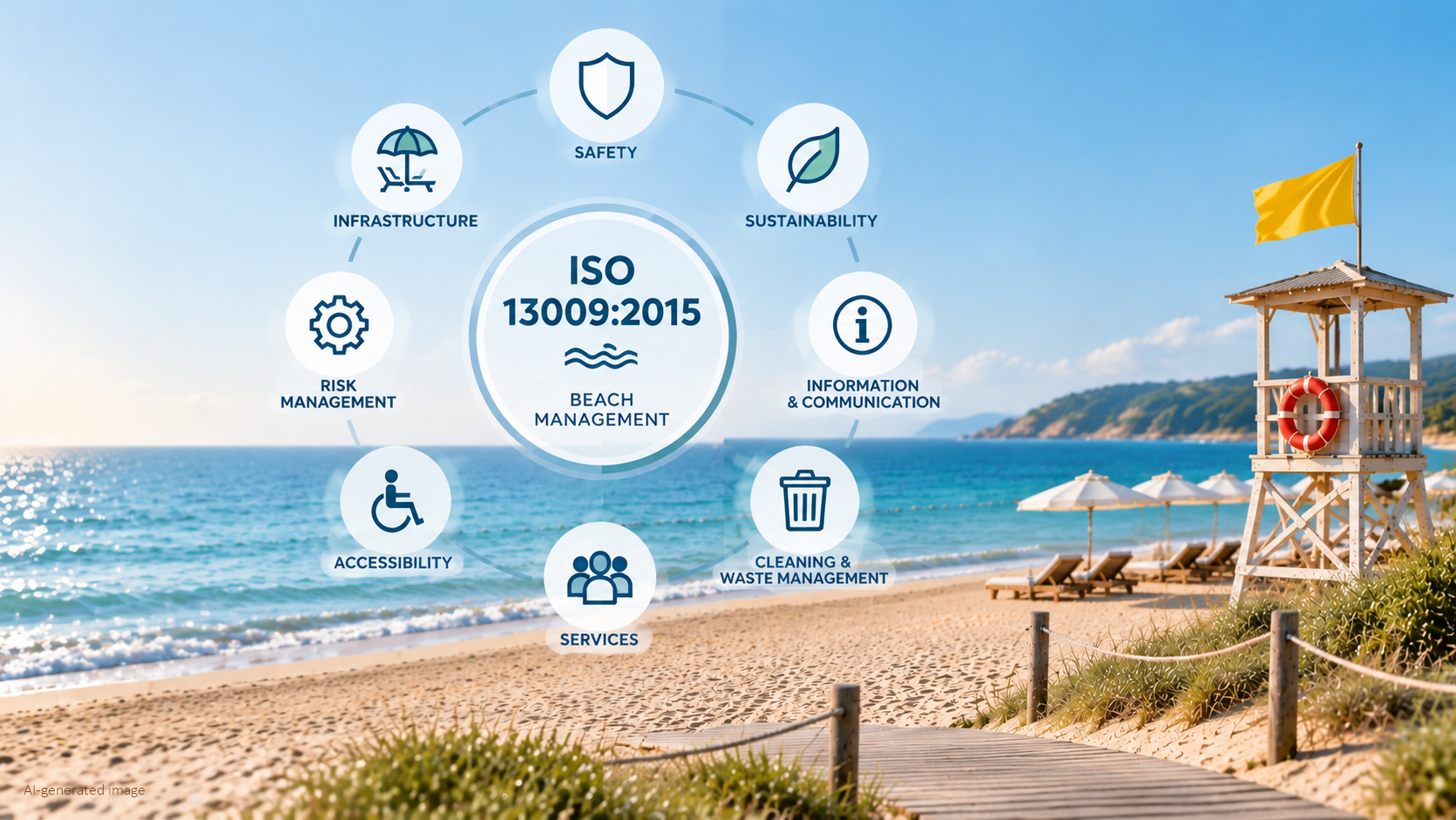 The quality of tourism services provided at coastal and other beaches depends on multiple factors, including safety, infrastructure, accessibility, cleanliness, visitor information and the organization of services. Managing these elements requires a structured approach that considers the specific characteristics of each beach and the expectations of its users.
Such a framework is provided by ISO 13009:2015 “Tourism and related services — Requirements and recommendations for beach operation”. The standard specifies requirements and recommendations for beach operators – concessionaires or operators responsible for beach areas that provide tourism and visitor services.
ISO 13009:2015 was published in 2015. In 2026, the standard underwent a systematic review and was confirmed by ISO. On 5 March 2026, ISO 13009:2015 reached status 90.93 – International Standard confirmed, meaning that the 2015 edition remains current and has not been replaced by a new edition.
What is ISO 13009?
ISO 13009 specifies general requirements and recommendations for concessionaires and users of beach areas that provide tourism and visitor services.
The standard is applicable to beaches during the bathing season and covers the organization of activities, service management and practical aspects of beach operation. Its scope includes sustainable management and planning, infrastructure, safety, information and communication, cleaning and waste removal.
ISO 13009 recognizes that every beach has its own specific characteristics. The management approach should therefore consider the particular features of each beach, its patterns of use and the results of risk assessment.
Main Areas Covered by ISO 13009 Requirements and Recommendations
The standard considers beach management as a combination of interconnected activities.
Management and planning
The beach operator should organize activities taking into account the bathing season, the use of different areas, beach access, applicable regulatory requirements and the need for infrastructure maintenance. ISO 13009 provides for the development of an operational plan, organization and maintenance plan.
Risk management and beach safety
The standard places significant emphasis on identifying and assessing risks related to the health and safety of visitors, including risks associated with water activities, the use of infrastructure and emergency situations.
Infrastructure and accessibility
ISO 13009 addresses requirements and recommendations regarding sanitary facilities, showers and foot-washing facilities, drinking water, changing rooms, temporary infrastructure, beach shade, beach access and opportunities for use by people with specific requirements.
Information and communication
The beach operator should provide up-to-date information regarding available services, safety, rules of conduct, operating hours, prices, water quality and other relevant aspects. The standard requires information to be accessible to different groups of users.
Cleaning and waste management
The standard includes requirements and recommendations for planning the cleaning of beaches, infrastructure and facilities, as well as for waste collection, separate collection and waste removal.
Commercial and recreational services
ISO 13009 also covers services such as food and beverage sales, rental of umbrellas and sun loungers, sports activities and recreational services, where such services are provided on the beach.
Risk Management as a Foundation of the Approach
One of the key elements of ISO 13009 is the relationship between beach management and risk assessment.
The standard requires the beach operator to identify risks related to activities, services, facilities and resources that may affect the health and safety of visitors.
Risk assessment may consider factors such as:
- bathing water quality;
- beach cleanliness;
- sanitary conditions;
- weather conditions;
- physical characteristics of the beach;
- erosion and flooding;
- flora and fauna;
- condition of facilities;
- safety information.
Beach Safety and Emergency Response
ISO 13009 considers safety as a fundamental element of the quality of services provided.
The standard includes requirements and recommendations regarding:
- safety signs and flags;
- zoning of different activities;
- lifeguard and rescue services;
- first aid;
- rescue equipment;
- emergency communication;
- procedures for coordinating and responding to missing and found persons.
Service Quality and Visitor Satisfaction
ISO 13009 is not limited only to infrastructure and safety.
The standard provides for the use of indicators to monitor the quality of services provided, environmental impacts, visitor health and comfort.
It also provides for mechanisms for handling complaints and suggestions, as well as evaluation of user satisfaction.
Through this approach, beach management is considered as a comprehensive tourism service that can be monitored, evaluated and improved.
Benefits of Applying ISO 13009
Applying ISO 13009 can support the beach operator in:
- achieving more structured management of activities;
- clearly defining responsibilities;
- systematically managing risks;
- improving service organization;
- better controlling infrastructure and maintenance;
- increasing visitor satisfaction;
- applying a sustainable approach to beach area management.
Who is ISO 13009 Applicable To?
ISO 13009 is intended for beach operators – concessionaires or users of beach areas responsible for managing and controlling activities related to the beach. The standard states that a beach operator may be a public organization or another organization legally assigned responsibility for beach management.
In Bulgaria, the standard can be useful for concessionaires, tenants and other organizations managing beach areas and providing tourism services.
The application of ISO 13009 does not replace national and local legal requirements but provides an international framework for the systematic management of beach activities.
More than ten years after its publication, ISO 13009:2015 continues to provide a structured framework for managing key aspects of beach operations – safety, infrastructure, services, communication, cleanliness and visitor satisfaction.
Implementation of management standards
CONSEJO Ltd. is a consulting company with over 20 years of practical experience in the development, implementation and maintenance of management systems in accordance with international standards and regulatory requirements. The company provides consulting services in the areas of quality management, environmental management, occupational health and safety, food safety, information security, cybersecurity, risk management and sustainable development. Our expertise covers standards and schemes such as ISO 9001, ISO 14001, ISO 45001, ISO 22000, ISO/IEC 27001, IFS Food, BRCGS and HACCP, as well as consulting services related to NIS2, DORA, GDPR and EcoVadis.
The CONSEJO team has been involved in over 1,500 projects for organizations across various sectors of the economy, including manufacturing, construction, energy, information technology, transport, trade, the food industry and services. Our approach focuses on developing management systems that work effectively in practice, tailored to the specific characteristics and needs of each organization. We work closely with our clients, providing consulting support, staff training and assistance during implementation. We strive to deliver high-quality services within the agreed deadlines and solutions that support successful certification and create long-term value for businesses.


