
European Commission Presents the European Technological Sovereignty Package
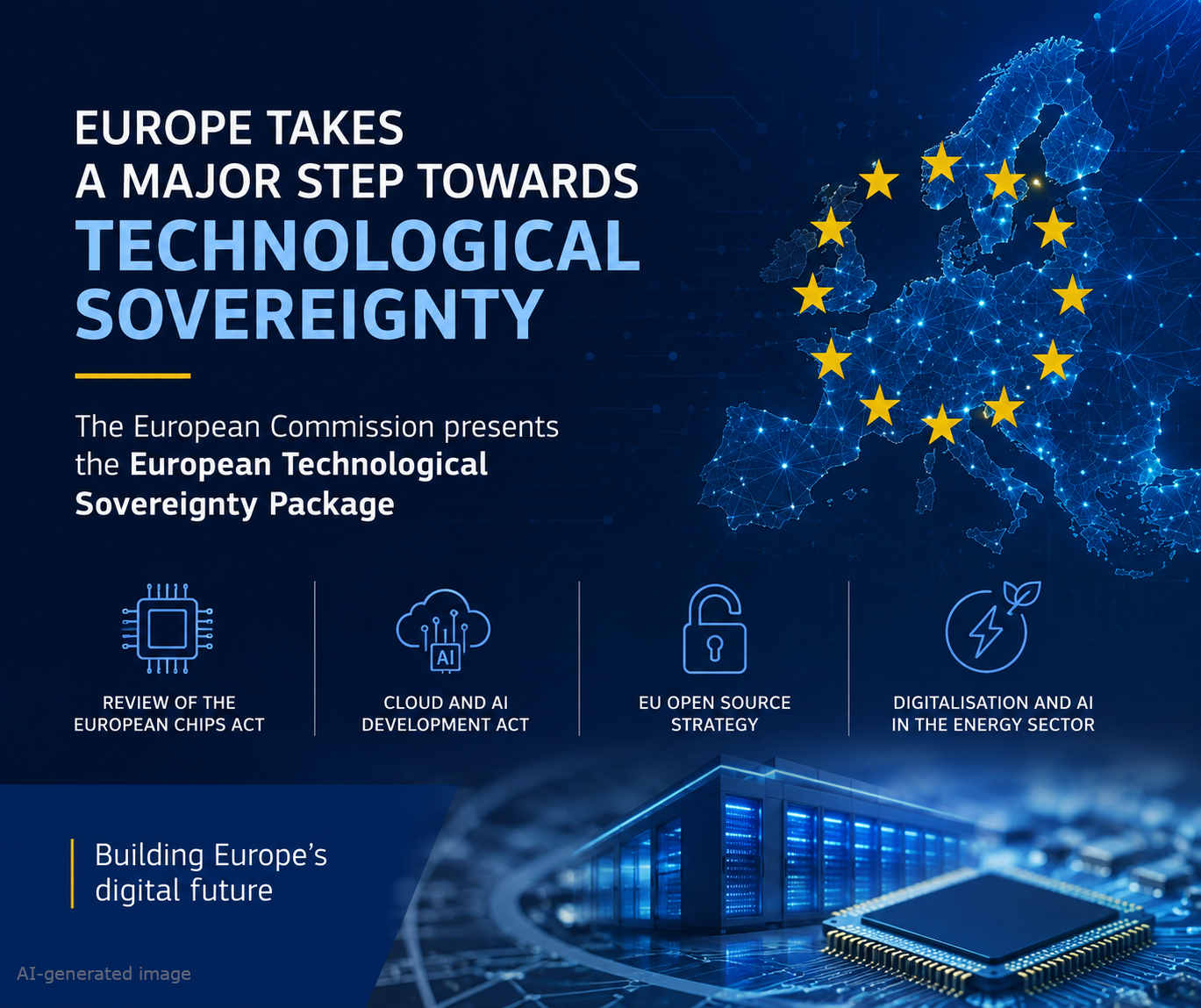 The European Commission has presented the European Technological Sovereignty Package, one of the most significant initiatives in the European Union's digital policy in recent years. The package aims to strengthen Europe's capacity in semiconductors, artificial intelligence, cloud technologies and open source software while enhancing the European Union's digital autonomy and technological resilience.
The package is part of the EU's broader strategy to strengthen competitiveness and economic security. It complements previously presented initiatives, including the Competitiveness Compass, the European Economic Security Strategy, and the AI Continent Action Plan, through which the European Commission seeks both to foster innovation and reduce the Union's strategic dependencies on technologies and infrastructure located outside the European Union.
The initiative comes at a time when the rapid advancement of generative artificial intelligence is transforming computing infrastructure, data centres and advanced semiconductor manufacturing into strategic resources comparable in importance to energy and transport infrastructure.
Why Is the European Union Taking This Step?
In recent years, the EU has become increasingly aware that a significant share of its critical digital infrastructure lies outside European control:
- the leading cloud service providers are U.S.-based companies;
- the world's most advanced AI chips are manufactured primarily outside the European Union, particularly in Asia;
- training the largest AI models requires computing capacity that Europe does not yet possess at sufficient scale.
Four Main Components
The package brings together two legislative proposals and two strategic initiatives that complement one another.
1. Review of the European Chips Act
The European Commission has proposed a review and strengthening of the European Chips Act.
Its main objectives are to:
- increase Europe's semiconductor manufacturing capacity;
- encourage investment in cutting-edge semiconductor technologies;
- reduce dependence on external suppliers;
- build a more resilient European semiconductor supply chain, including for AI infrastructure.
2. Cloud and AI Development Act
The second legislative proposal is the Cloud and AI Development Act (CADA).
The proposal includes measures to:
- accelerate the development of European data centres;
- simplify permitting procedures;
- stimulate both public and private investment;
- establish a European framework for assessing cloud and AI sovereignty;
- develop high-performance infrastructure for training and deploying AI models;
- promote research and innovation in artificial intelligence.
3. EU Open Source Strategy
For the first time, the European Commission positions open source software as a strategic component of Europe's digital independence.
The strategy envisages investments in:
- European open source solutions;
- start-ups;
- digital infrastructure;
- skills development;
- wider adoption of open source software across the public sector.
4. Digitalisation and AI in the Energy Sector
The fourth component is a strategic roadmap for the digital transformation of the energy sector.
It includes measures to:
- integrate data centres into the energy system;
- use AI to optimise electricity grid management;
- develop secure European AI solutions for the energy sector;
- improve the energy efficiency of digital infrastructure.
Connection with the AI Continent Initiative
The new package is closely linked to the AI Continent Action Plan, previously presented by the European Commission, whose objective is to make Europe the preferred location for developing, training and deploying artificial intelligence.
In July 2026, the European Commission launched a call for expressions of interest to establish up to seven AI Gigafactories across Europe. The initiative provides for up to €10 billion in public funding, with the aim of attracting at least €20 billion in private investment. Each AI Gigafactory is expected to be equipped with approximately 100,000 high-performance AI processors—around four times the capacity of today's European AI Factories.
What Does It Mean for Businesses?
Although a significant part of the package still consists of legislative proposals that must be considered by the European Parliament and the Council of the European Union, its strategic direction is already clear.
Over the coming years, European organisations can expect:
- a substantial increase in public investment in AI infrastructure;
- new funding opportunities for innovative technology projects;
- continued development of European cloud services and high-performance computing infrastructure;
- broader adoption of open source solutions;
- the likely gradual introduction of stronger digital sovereignty requirements, particularly in public procurement and critical infrastructure.
For Bulgaria, the initiative creates new opportunities to participate in future European projects related to artificial intelligence, high-performance computing, cloud technologies and the semiconductor industry.
Organisations already developing or deploying AI systems should closely monitor the progress of the new legislative proposals. Future EU investment programmes are likely to place greater emphasis on the use of European digital infrastructure, secure cloud services and technologies aligned with the requirements of the EU AI Act, NIS2, the Data Act, the Data Governance Act, and the broader European digital regulatory framework.
With the European Technological Sovereignty Package, the European Commission is taking an important step beyond regulating digital technologies. While recent years have focused primarily on establishing a common regulatory framework through legislation such as the EU AI Act, the Data Act, and NIS2, the emphasis is now gradually shifting towards building Europe's own technological capacity.
Europe's ambition is not only to regulate artificial intelligence, but also to develop and operate its own high-performance computing infrastructure, modern data centres, a competitive semiconductor industry and a resilient innovation ecosystem. The ability to develop, deploy and use these technologies within a European environment will be a key factor in strengthening the European Union's digital independence, economic resilience and global competitiveness over the coming decade.
Implementation of management standards
CONSEJO Ltd. is a consulting company with over 20 years of practical experience in the development, implementation and maintenance of management systems in accordance with international standards and regulatory requirements. The company provides consulting services in the areas of quality management, environmental management, occupational health and safety, food safety, information security, cybersecurity, risk management and sustainable development. Our expertise covers standards and schemes such as ISO 9001, ISO 14001, ISO 45001, ISO 22000, ISO/IEC 27001, IFS Food, BRCGS and HACCP, as well as consulting services related to NIS2, DORA, GDPR and EcoVadis.
The CONSEJO team has been involved in over 1,500 projects for organizations across various sectors of the economy, including manufacturing, construction, energy, information technology, transport, trade, the food industry and services. Our approach focuses on developing management systems that work effectively in practice, tailored to the specific characteristics and needs of each organization. We work closely with our clients, providing consulting support, staff training and assistance during implementation. We strive to deliver high-quality services within the agreed deadlines and solutions that support successful certification and create long-term value for businesses.


