
Change Management in the Food Sector: When Is a New Risk Assessment Necessary?
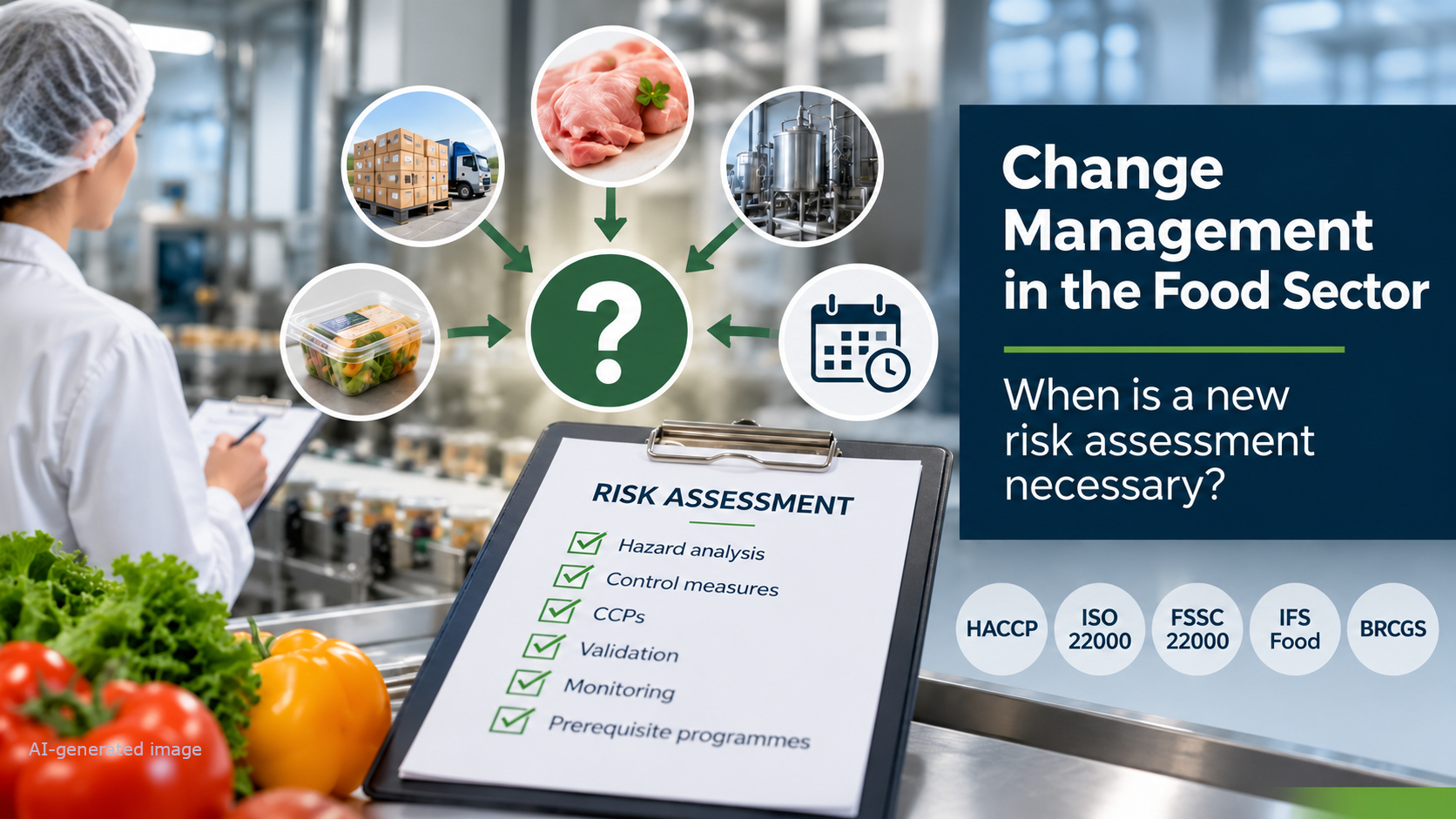 Changing a supplier may seem like a routine commercial decision, while extending a product's shelf life may be seen as an opportunity to improve the marketability of the product. However, both changes can affect food safety. If the new raw material has different characteristics or there is insufficient evidence to support the extended shelf life, the existing control measures may prove inadequate.
Effective change management is therefore an essential part of the food safety management system. It enables potential risks to be identified in advance and the necessary actions to be taken before a change is implemented.
Different stages of a company's operations may be affected by changes – from the selection of raw materials and suppliers to production processes, storage and distribution. It is therefore important to assess their impact on food safety in a timely manner and determine the necessary measures before implementing them.
Which Changes Require a Review of the Risk Assessment?
Not every change requires a complete revision of the HACCP system. However, for any change that may affect food safety, it is necessary to determine whether it affects the identified hazards, established control measures or their effectiveness.
1. Introduction of a New Product or Changes to the Formulation
A new product or a change in its composition may introduce hazards that were not covered by the initial hazard analysis.
Reasons for reassessment include replacing ingredients, changing acidity or moisture content, modifying processing methods or changing the type of packaging. Particular attention is required when introducing allergens and developing ready-to-eat products.
The company must assess whether the existing control measures remain sufficient and whether changes to processing parameters, allergen control or label information are necessary.
2. Change of Supplier or Raw Material
A new supplier may use different production, processing and storage methods, which may affect the microbiological characteristics of raw materials or the presence of contaminants.
When changing suppliers, it is necessary to determine whether the existing specifications, acceptance criteria and incoming inspection procedures ensure the required level of safety. Depending on the risk, additional documentation, testing or changes to supplier requirements may be necessary.
A similar assessment is required when changing packaging materials, processing aids or chemical preparations that may affect product safety.
3. Changes to Production Technology or Equipment
New equipment, the automation of operations or changes to the sequence of production stages may affect processing times, temperature conditions and measures to prevent contamination.
For example, increasing production capacity may change cooling times, while new equipment may have different temperature control characteristics.
Checking that equipment operates correctly does not, in itself, demonstrate that the process effectively controls hazards. Depending on the change, process validation, verification of critical limits, updates to monitoring procedures or a review of critical control points (CCPs) may be necessary.
4. Changes to Premises and Production Organisation
Expanding production areas, relocating operations or changing the movement of raw materials, finished products, personnel and waste may create conditions for cross-contamination.
Such changes require an assessment of hygienic zoning, the separation of incompatible operations, the potential transfer of allergens and microorganisms, and the effectiveness of cleaning and disinfection.
Where necessary, prerequisite programmes (PRPs) are updated, including those relating to hygiene, pest control and the maintenance of appropriate production conditions.
5. Changes to Storage, Packaging and Distribution
Changes to temperature conditions, packaging technology, logistics arrangements or shelf life may affect product stability and microbiological safety.
Any extension of shelf life must be supported by appropriate evidence demonstrating that the product remains safe under the intended conditions of storage and use.
Depending on the product's characteristics, testing, shelf-life studies or checks of transport conditions, the cold chain and the protective properties of packaging may be necessary.
6. Changes to Personnel and Work Organisation
Introducing new shifts, using temporary staff, changing responsibilities or outsourcing activities may affect compliance with hygiene practices and control procedures.
It is necessary to assess whether responsibilities are clearly assigned, personnel have the required competence and control activities are carried out consistently.
For example, a change in cleaning methods or responsibility for temperature monitoring may require updated instructions, training and additional checks.
7. New Information and Findings from In-house Controls
A review of the risk assessment may also be necessary even when no changes to production are planned.
Possible reasons include:
- New scientific data on hazards associated with raw materials or products;
- Alerts in the Rapid Alert System for Food and Feed (RASFF);
- Changes in regulatory requirements;
- Customer complaints, product withdrawals or recalls;
- Repeated deviations from processing parameters;
- Findings from internal, external or certification audits.
How Should Change Management Be Organised?
Effective change management begins before a change is implemented and involves five main steps.
1. Identification and Description of the Change
The reason for the change and the affected products, processes, premises, suppliers or control activities are identified.
2. Assessment of the Impact on Food Safety
The assessment determines whether new hazards arise, whether existing risks change and whether control measures remain effective.
3. Determination of Necessary Actions
Where necessary, the hazard analysis, HACCP plan, prerequisite programmes, specifications and instructions are updated. Required testing, validation and training are planned.
4. Verification Before Implementation
Checks are carried out to confirm that the planned measures have been implemented and that the process can be safely controlled under the new conditions. These may include checks of equipment, temperature conditions, hygiene and critical limits.
5. Documentation and Follow-up Verification
The assessment, decisions, actions taken and responsibilities are documented. Following implementation, verification is carried out to confirm that the control measures are being applied and are operating effectively.
Change Management Under HACCP, ISO 22000, FSSC 22000, IFS and BRCGS
Change management is linked to maintaining an up-to-date hazard analysis and effective control measures. The requirements arise from legislation and the applicable standards and certification schemes.
Regulation (EC) No 852/2004, Article 5, requires food business operators to review procedures based on HACCP principles and make the necessary changes whenever any modification is made to the product, process or any step. Documentation describing these procedures must be kept up to date.
ISO 22000:2018 includes requirements for planning changes to the food safety management system (Clause 6.3) and for updating information concerning prerequisite programmes and the hazard control plan (Clause 8.6).
FSSC 22000 builds on ISO 22000 through applicable sector-specific prerequisite programmes and additional scheme requirements. Version 7 provides for a documented, risk-based process for managing new or modified equipment. This includes an assessment of the impact on existing systems and evidence of successful commissioning. The assessment therefore goes beyond the technical condition of the equipment and also covers the impact of the change on food safety.
IFS Food and BRCGS also include requirements for assessing and controlling changes that may affect product safety, quality and compliance. Specific obligations depend on the applicable standard, its edition and the scope of activities.
A new risk assessment does not automatically require a complete revision of the HACCP plan. If the documented assessment demonstrates that the change does not affect the identified hazards and that existing control measures remain sufficient, there is no need for unnecessary revisions to the documentation.
If new hazards, changes in the risk assessment or insufficient effectiveness of existing control measures are identified, the hazard analysis and, where necessary, the HACCP plan must be updated to the appropriate extent.
Change management is not solely the responsibility of the HACCP team. Management, production, procurement, maintenance, quality and logistics functions must be involved according to their respective responsibilities.
How Can CONSEJO Help?
CONSEJO supports food sector companies in the implementation of management system standards, including ISO 22000, FSSC 22000, IFS Food and BRCGS, by aligning management systems with the specific characteristics of their operations, applicable requirements and identified risks.
For organisations with already implemented systems, we offer revision, updating and improvement of management systems, including reviewing hazard analyses, updating HACCP documentation and adapting existing control measures to changes in products, processes and work organisation.
Implementation of management standards
CONSEJO Ltd. is a consulting company with over 20 years of practical experience in the development, implementation and maintenance of management systems in accordance with international standards and regulatory requirements. The company provides consulting services in the areas of quality management, environmental management, occupational health and safety, food safety, information security, cybersecurity, risk management and sustainable development. Our expertise covers standards and schemes such as ISO 9001, ISO 14001, ISO 45001, ISO 22000, ISO/IEC 27001, IFS Food, BRCGS and HACCP, as well as consulting services related to NIS2, DORA, GDPR and EcoVadis.
The CONSEJO team has been involved in over 1,500 projects for organizations across various sectors of the economy, including manufacturing, construction, energy, information technology, transport, trade, the food industry and services. Our approach focuses on developing management systems that work effectively in practice, tailored to the specific characteristics and needs of each organization. We work closely with our clients, providing consulting support, staff training and assistance during implementation. We strive to deliver high-quality services within the agreed deadlines and solutions that support successful certification and create long-term value for businesses.


